
Generative AI and large language models are moving rapidly from experimental technology into everyday professional work. As companies adopt AI for software development, research, content creation, customer service and business operations, the technology is also changing the skills workers need to build sustainable careers.
Generative AI Moves Into Everyday Work
Generative AI systems can create text, code, images, audio and other digital content based on user instructions. Large language models, or LLMs, power many of the text-based AI applications used for writing, research, programming, summarisation and communication.
The technology is developing beyond simple question-and-answer systems. New AI applications can connect to external tools, retrieve information, analyse files and complete multiple steps within a single workflow.
India’s AI Skills Demand Is Growing
AI adoption is becoming increasingly visible across India’s technology and business sectors. Companies are using AI to automate repetitive work, assist employees and develop new products and services.
The changing demand is also affecting recruitment. Employers are increasingly looking for candidates who understand AI tools alongside conventional technical or professional skills.
What You Need to Learn First
A career in AI does not begin with advanced language models. Strong fundamentals in programming, data structures, databases and software development can provide the foundation for building AI applications.
Python is widely used across machine learning and AI development. Learners should also understand basic statistics, probability and linear algebra because these concepts help explain how machine learning systems are trained and evaluated.
Move From Machine Learning to LLMs
After learning the fundamentals, aspiring AI professionals can study machine learning and deep learning. Topics include supervised learning, neural networks, model training, evaluation and optimisation.
The next step can be an introduction to transformers and large language models. Rather than training a large model from scratch, developers can initially learn to build applications using existing models through APIs and open-source tools.
Build Real AI Projects
Practical projects can help turn theoretical knowledge into demonstrable skills. Examples include document question-answering systems, AI research assistants, customer-support applications, coding tools and retrieval-augmented generation systems.
Projects also expose developers to real-world problems such as inaccurate AI output, data quality, security, latency and operating costs. Understanding these limitations is an important part of professional AI development.
New AI Career Paths
The growth of generative AI is creating opportunities across several technical and business roles. AI engineers and machine learning engineers build and deploy AI systems, while NLP specialists work on language-related applications.
MLOps professionals focus on deploying and monitoring machine learning systems. Other emerging roles include AI product managers, AI evaluators, responsible-AI specialists, AI security professionals and AI solutions architects.
Agentic AI Adds a New Layer
AI agents are designed to do more than generate responses. They can plan tasks, use software tools, retrieve information and perform multiple actions based on a user’s objective.
This creates another area of opportunity for developers who understand how to design agent workflows. Knowledge of APIs, tool permissions, evaluation, monitoring and human oversight becomes important when AI systems can take actions independently.
Human Skills Remain Important
Technical AI knowledge is only one part of the changing career landscape. Communication, analytical thinking, creativity, problem-solving and professional judgement remain important because AI-generated results require context and verification.
Combining AI knowledge with expertise in a particular field can also create valuable career opportunities. Professionals who understand both technology and an industry problem can identify practical applications that general-purpose AI knowledge alone may not reveal.
Experience Matters
Certificates and courses can help learners build structured knowledge, but practical experience provides another way to demonstrate capability. Building applications, contributing to open-source projects, completing internships and deploying working AI tools can strengthen a portfolio.
Existing professionals can also begin by applying AI to tasks in their current jobs. Automating repetitive processes, improving research or developing internal tools can provide practical experience without requiring an immediate career change.
Learn Concepts, Not Just Tools
AI products and models are changing quickly. A career strategy based entirely on one application or prompt technique can become outdated as new systems appear.
Learning the underlying concepts of machine learning, LLMs, data, software engineering and AI evaluation can make it easier to adapt when technologies change. Continuous learning is likely to remain an important part of AI-related careers.
The Career Roadmap
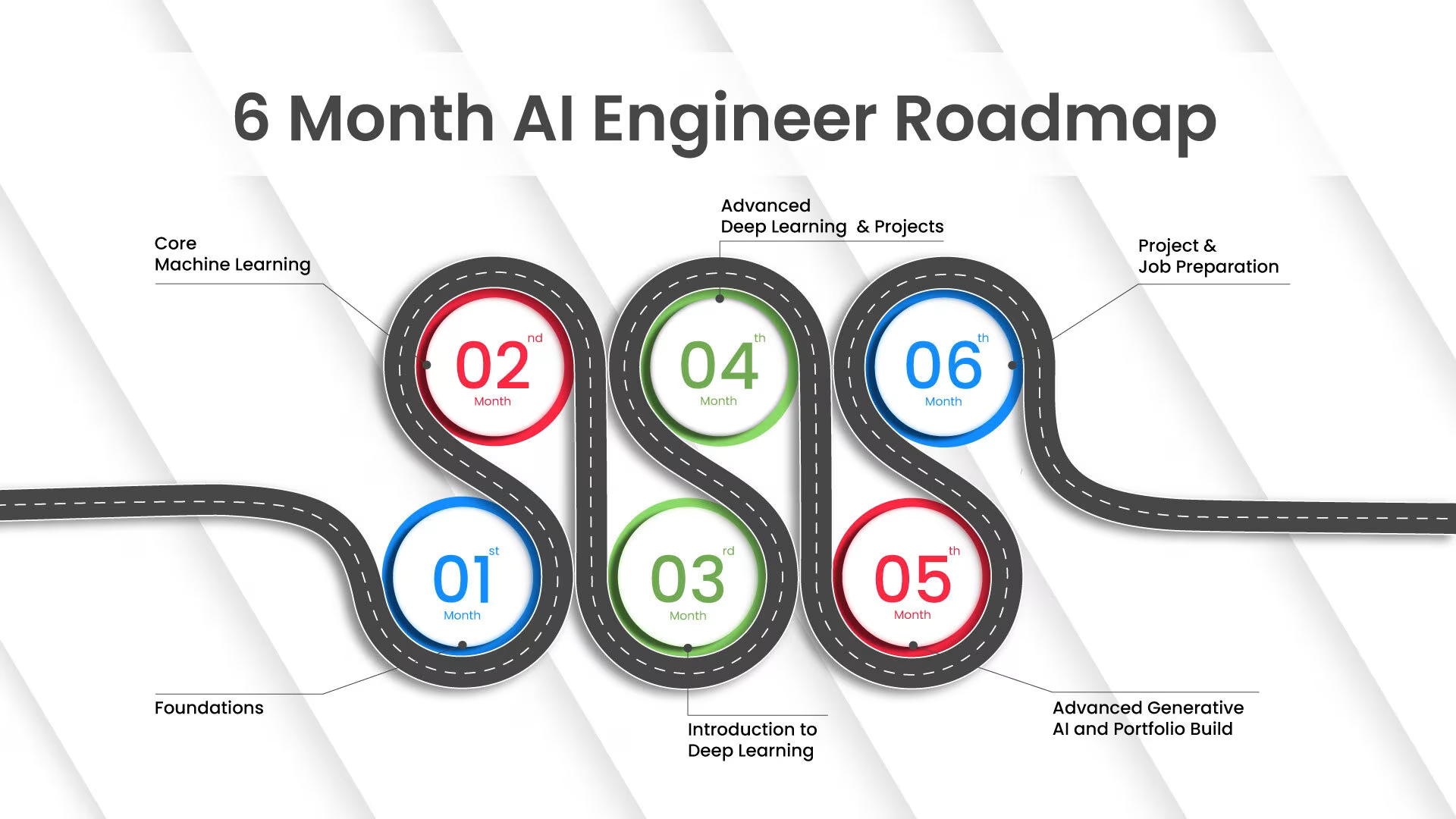
A practical roadmap can begin with programming and computer science fundamentals, followed by mathematics, statistics, data handling and machine learning. Learners can then move into deep learning, transformers, LLM applications, retrieval systems and AI agents.
The final stage is applying those skills to real business or industry problems. A strong portfolio can demonstrate not only that someone understands AI, but also that they can build useful systems, evaluate their performance and manage their limitations.
The Latest Direction
Generative AI is continuing to expand from standalone chat applications into software development, business workflows and AI-powered products. For workers and students, the changing market makes AI literacy increasingly relevant across technical and non-technical careers.
The most durable career path is likely to combine technical understanding, practical project experience, domain expertise and the ability to adapt as AI systems evolve. The technology will continue to change, but the need to understand problems, evaluate solutions and use AI responsibly remains central to building an AI-focused career.