
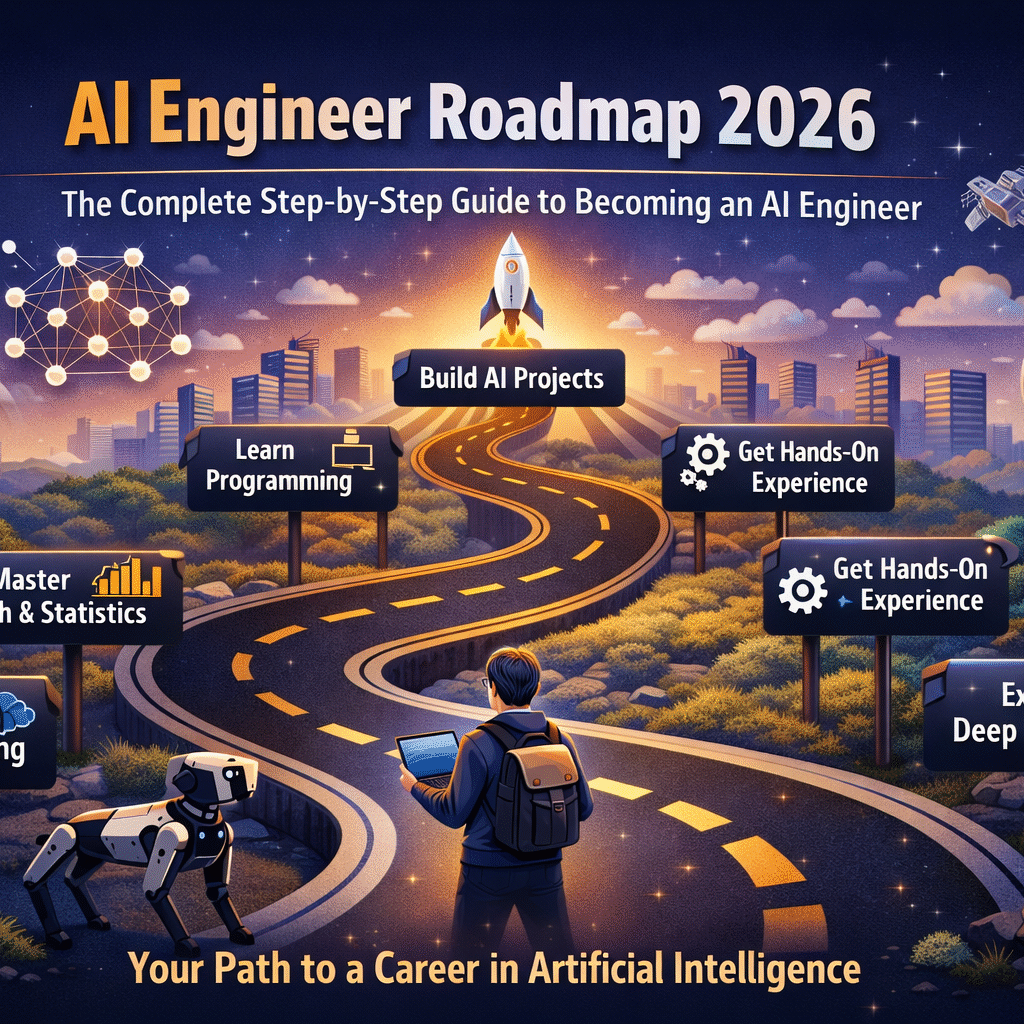
The learning priorities for 2026 and 2027 are changing as artificial intelligence becomes part of software development, data analysis, marketing, business operations and other professional fields. A practical roadmap combines AI literacy with technical foundations, hands-on projects and human skills such as critical thinking and problem-solving.
Start with AI literacy
The first step is learning what generative AI can do, where it can fail and how to use it responsibly. This includes prompt design, choosing suitable AI tools, checking generated information, understanding privacy risks and recognizing when human review is required.
AI literacy is useful across technical and non-technical careers because many workplaces are adding AI tools to existing workflows rather than creating entirely separate AI departments.
Build technical foundations
AI skills are easier to apply when combined with established technical knowledge. For people entering technical fields, useful foundations include Python, SQL, statistics, databases, APIs, Git and basic software development.
These skills help learners understand how AI applications connect to data, software and business systems. They also make it easier to build applications instead of relying only on ready-made AI interfaces.
Learn generative AI
The next stage can cover large language models, embeddings, retrieval-augmented generation, multimodal AI and model evaluation. Learners can then apply those concepts to practical projects.
Useful projects include document question-answering systems, AI assistants, content-analysis applications and tools that connect language models with external databases or information sources.
Add AI agents and automation
AI agents are becoming an important part of the technology learning landscape. Learners can study tool calling, workflow orchestration, APIs, retrieval, memory, agent evaluation and automation.
Instead of simply asking an AI system a question, an agent workflow can be designed to perform several connected tasks. Building and testing these workflows can provide practical experience with modern AI applications.
Develop data and evaluation skills
AI systems depend on reliable data and careful evaluation. Learners should practice data cleaning, analysis, testing and validation alongside AI development.
Critical evaluation is especially important because AI systems can produce inaccurate or incomplete information. Learning how to verify outputs and identify errors is part of using AI effectively in professional environments.
Learn cybersecurity and responsible AI
As AI systems become connected to company applications and sensitive information, security and governance become increasingly relevant. Learning areas can include data privacy, access controls, prompt-injection risks, model security and responsible AI practices.
These topics are useful for both developers and professionals who manage AI systems or use them with organizational data.
Strengthen human skills
Technical AI skills do not replace communication, analytical thinking, creativity, collaboration and decision-making. Employers continue to identify these capabilities as important alongside technology skills.
Critical thinking is particularly relevant because workers need to decide whether AI-generated information is accurate, useful and appropriate for a particular task.
Build a practical portfolio
By 2027, learners can demonstrate their skills through practical projects rather than relying only on certificates. A portfolio can include AI applications, automation workflows, data projects, evaluation reports and examples showing how AI improved a specific process.
The World Economic Forum estimates that a substantial share of workers will need reskilling or upskilling by 2030 as job requirements change. Continuous learning is therefore becoming part of the wider transition to an AI-enabled workplace.
A practical 2026–2027 roadmap can be organized as a progression from AI literacy to technical foundations, generative AI, agents and automation, data evaluation, security and responsible AI, followed by continuous development of human skills. The exact path can be adjusted according to the learner’s career and existing experience.