
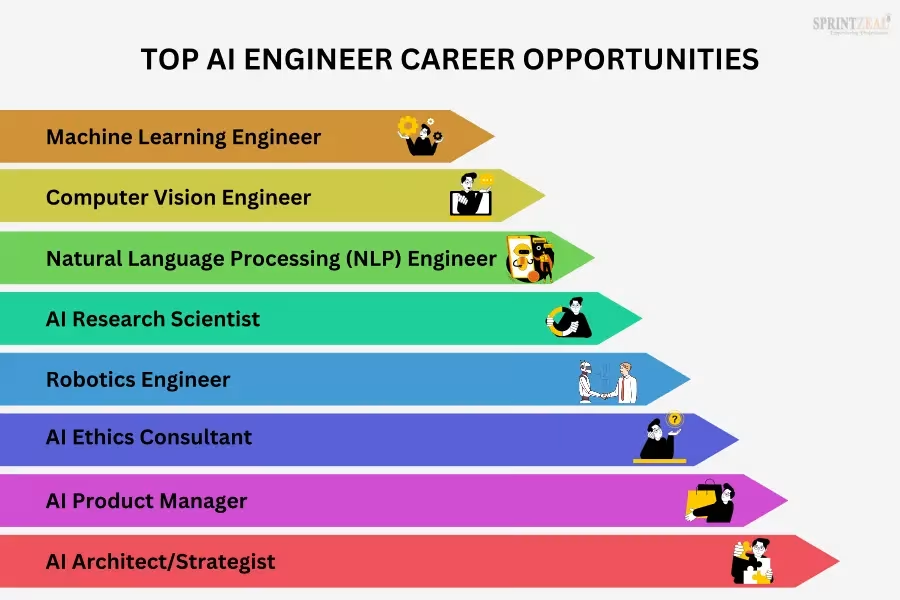
Artificial intelligence engineering has become a broad career field covering machine learning, generative AI, automation, data systems, and AI-powered software development. As businesses integrate AI into products and operations, engineers can pursue specialized roles based on their technical skills and career interests.
1. Machine Learning Engineer
Machine learning engineers develop and deploy systems that learn from data. Their work can include preparing datasets, selecting algorithms, training models, improving performance, and integrating models into production applications.
2. Generative AI Engineer
Generative AI engineers build applications using large language models and other generative systems. Their work may involve prompt engineering, retrieval-augmented generation, model evaluation, fine-tuning, and AI workflow development.
3. AI Software Engineer
AI software engineers combine software development with artificial intelligence capabilities. They build applications using machine learning models, AI APIs, recommendation systems, natural language processing, and computer vision.
4. Computer Vision Engineer
Computer vision engineers develop systems that interpret images and video. Applications include manufacturing inspection, medical imaging, autonomous systems, retail analytics, and augmented reality.
5. Natural Language Processing Engineer
Natural language processing engineers develop systems that understand and process human language. Their work can include search, classification, summarization, translation, conversational AI, and language-model applications.
6. AI Solutions Architect
AI solutions architects design the technical structure of AI systems and determine how artificial intelligence can be integrated into existing infrastructure. They consider scalability, security, data pipelines, model selection, and operational requirements.
7. MLOps Engineer
MLOps engineers focus on deploying, monitoring, maintaining, and updating machine learning systems in production. Skills in cloud computing, DevOps, data engineering, automation, and machine learning are useful for this role.
8. AI Research Engineer
AI research engineers work on developing and testing new artificial intelligence methods. They may study model architectures, training techniques, optimization, evaluation methods, and emerging AI technologies.
Skills for an AI Engineering Career
AI engineering careers generally require strong programming and technical foundations. Python, algorithms, statistics, machine learning, deep learning, databases, APIs, cloud computing, and software engineering are valuable skills across many roles.
Professionals can also benefit from learning about large language models, AI agents, retrieval-augmented generation, model evaluation, responsible AI, security, and data privacy. Practical projects can demonstrate the ability to apply these skills to real-world problems.
Choosing the Right Career Path
The right AI engineering career depends on individual interests and strengths. Engineers interested in predictive models may prefer machine learning, while those focused on language applications may choose NLP or generative AI. Professionals interested in infrastructure may pursue MLOps, while those who enjoy system design may move toward AI architecture.
Latest Status
AI engineering continues to expand as organizations adopt generative AI, intelligent automation, and AI-powered software. Developing strong software and data fundamentals alongside practical experience with modern AI technologies can help engineers adapt to changing opportunities in the field.