
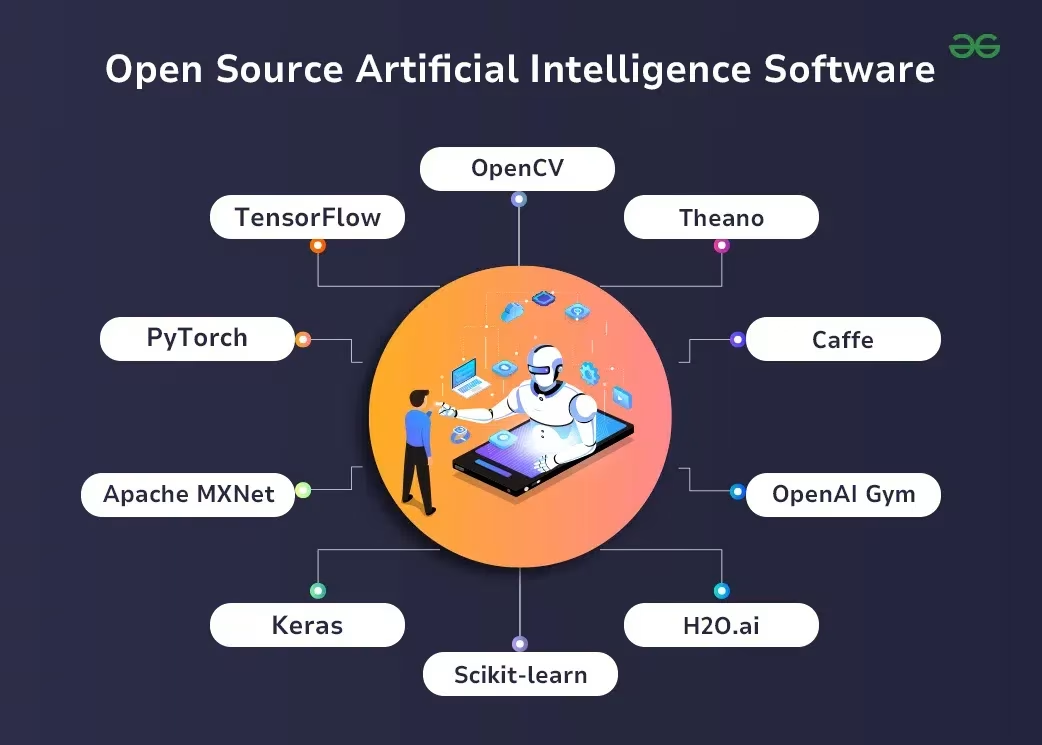
Open source artificial intelligence software gives developers, researchers, startups, and businesses flexible tools for building and deploying AI applications. These projects cover machine learning, deep learning, natural language processing, computer vision, data processing, and generative AI.
1. TensorFlow
TensorFlow is an open source machine learning framework used to develop and deploy machine learning and deep learning applications. It provides tools for model training, evaluation, and production deployment.
2. PyTorch
PyTorch is an open source machine learning framework widely used for research and production applications. It supports deep learning, computer vision, natural language processing, and generative AI development.
3. Scikit-learn
Scikit-learn is an open source Python library for traditional machine learning. It provides tools for classification, regression, clustering, preprocessing, dimensionality reduction, and model evaluation.
4. Hugging Face Transformers
Hugging Face Transformers provides open source tools and pretrained models for natural language processing and other AI applications. Its ecosystem also supports vision, audio, and multimodal machine learning projects.
5. Keras
Keras is an open source deep learning framework designed to simplify neural network development. It provides high-level APIs for building, training, and deploying modern machine learning models.
6. OpenCV
OpenCV is an open source computer vision library used for image and video processing. Developers can use it for object detection, image transformation, feature extraction, video analysis, and other visual AI applications.
7. JAX
JAX is an open source numerical computing framework designed for high-performance machine learning and scientific computing. It supports automatic differentiation and compilation for advanced model development and research.
8. Apache Spark
Apache Spark is an open source distributed computing platform that includes machine learning capabilities through MLlib. It is useful for processing large datasets and developing scalable data and machine learning workflows.
9. Rasa
Rasa is an open source framework for developing conversational AI applications. It allows developers to build assistants and chatbots while maintaining control over conversation logic, natural language understanding, and integrations.
10. Apache TVM
Apache TVM is an open source machine learning compiler framework designed to optimize and deploy models across different hardware platforms. It can help developers improve AI model performance and portability.
How to Choose Open Source AI Software
The best software depends on the project’s goals, programming environment, model requirements, available hardware, deployment needs, and technical expertise. Developers should also review documentation, licensing, security, community activity, and long-term maintenance before adopting a project.
Benefits of Open Source AI Software
Open source AI projects can provide developers with greater control over their technology stack. They can inspect code, customize software, integrate different components, and benefit from contributions made by research and developer communities.
Latest Status
Open source AI continues to expand across machine learning, generative AI, computer vision, natural language processing, and model deployment. Developers now have a broad ecosystem of frameworks and tools for creating customized artificial intelligence solutions.