
Machine Learning Engineer Roadmap Beginner: A 2026 Complete Guide
Machine Learning is not restricted to research laboratories or tech companies anymore. Nowadays, ML systems are being used to automate decisions and enhance performance by startups, e-commerce brands, healthcare companies, and even small businesses.
In case you are asking yourself whether you can be a Machine Learning Engineer with no formal degree the simple answer is: yes, you can. However, it needs to be learned in structure, with basics, and practical projects.
We can deconstruct a practitioner-friendly roadmap.
What Does a Machine Learning Engineer Actually Do?
A Machine Learning Engineer creates, trains, tests, and launches machine learning systems. They are more concerned with:
- Coding at the production level.
- Designing ML pipelines
- Working with large datasets
- Implementing models into practice.
They are collaborating with Data Scientists, software engineers, and DevOps teams in most companies.
Do You Really Need a Degree?
It is not a requirement, although a degree in computer science is beneficial. A good number of ML engineers are either self-educated or non-technical.
Examples of what employers are really seeking:
- Strong programming skills
- Algorithms knowledge.
- Hands-on ML projects
- Problem-solving ability
- GitHub portfolio
In the case that you are able to show these, then your degree is not so important.
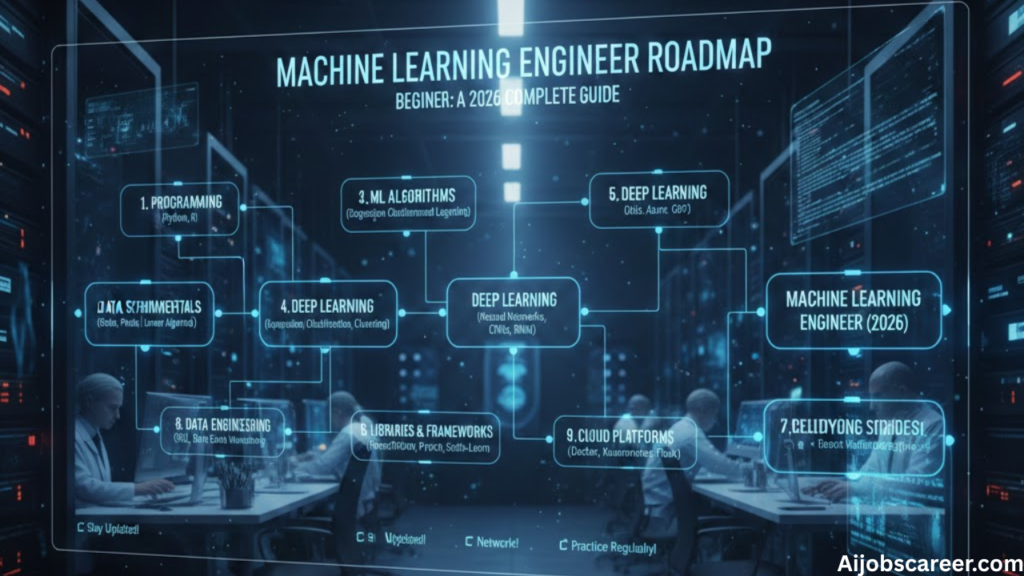
Roadmap to Becoming a Step-by-Step Machine Learning Engineer
Step 1: Master Programming (Begin with Python)
The machine learning machine standard in the industry is python.
You are at ease with:
- Variables and data types
- Loops and conditionals
- Functions
- Object-Oriented Programming
- Working with files
- Basic debugging
Practice daily. Coding confidence can be built with the help of platforms such as Kaggle and GitHub.
Step 2: Learn Basic Math
You do not need to be a math major on the Ph.D. level, but you do have to realize:
- Linear algebra (vectors, matrices).
- Probability and Statistics.
- Basic Calculus (derivatives).
These were the concepts used in machine learning algorithms. In their absence, models will become like magic formulas.
Step 3: Learn Fundamentals of machine learning
Master the fundamentals of deep learning: Unsupervised vs Supervised Learning.
- Regression
- Classification
- Clustering
- Overfitting and Underfitting.
- Bias-Variance tradeoff
Study algorithms like:
- Linear Regression
- Logistic Regression
- Decision Trees
- Random Forest
- K-Nearest Neighbors
These can be implemented with Scikit-learn which is popular in traditional machine learning.
Step 4: Master Data Management and Visualization
Real ML work is 60-70 data cleaning.
You must learn:
- Data preprocessing
- Handling missing values
- Feature engineering
- Data normalization
Important tools:
- Pandas
- NumPy
- Matplotlib
These tools are useful in manipulating and analysing data.
Step 5: Deep Learning (Not Mandatory but Suggested)
After understanding the basics, then proceed to deep learning.
Learn:
- Neural Networks.
- Activation functions.
- Backpropagation.
- Convolutional Neural Networks (CNNs).
- There are Recurrent Neural Networks (RNNs).
Popular frameworks:
- TensorFlow
- PyTorch
Deep learning finds particular application in AI-related fields such as computer vision, NLP and speech recognition.
Step 6: Work on Real Projects
This is the most significant section.
Build projects like:
- House price forecasting model.
- Spam email classifier
- Recommendation movie system.
- Chatbot
- Resume screening system
- Put it all into GitHub with proper documentation.
- Employers have more trust in projects as opposed to certificates.
Step 7: Learning Model Deployment (Very Important)
Most of the novices halt with model training. However, companies desire engineers who are capable of using models.
Learn:
- REST APIs.
- Flask or FastAPI.
- Docker basics.
- Cloud solutions (AWS, Azure, GCP).
Model deployment qualifies you to work.
Step 8: Understand MLOps
Contemporary ML engineering comprises MLOps (Machine Learning Operations).
This includes:
- Version control
- CI/CD pipelines
- Model monitoring
- Experiment tracking
Even the entry-level exposure is an advantage.
Machine Learning Engineer: Skills and Qualifications
Here’s a quick summary:
Technical Skills
- Python programming
- Algorithms and data structures.
- SQL basics
- ML frameworks
- Model deployment
Soft Skills
- Logical thinking
- Debugging ability
- Communication
- Ongoing education attitude.
How Long Does It Take?
If you study consistently:
- 3-4 months – Math basics + Programming.
- 3-4 months – Core ML concepts
- 2-3 months – Projects + Deployment
You can get job-ready in 8-12 months.
Speed is not as important as consistency.
Salary Expectations (2026)
Machine learning engineers are one of the most well-paying technical specialists.
In India:
- Entry-level: 6-12 LPA
- Mid-level: 15-25 LPA
Globally:
- Between $90 000 -160,000 per year (according to the location).
The remunerations depend on the skills, portfolio, and practical experience.
Best Learning Resources
You can learn from:
- YouTube tutorials
- Kaggle competitions
- Open-source projects
- Online bootcamps
- TensorFlow and PyTorch documentation.
Pay attention to practice, not only theory.
Final Thoughts: Is It Worth It?
Yes in the event that you truly like to problem solve and work with data.
- You don’t need a degree.
- You do not require costly qualifications.
- You require projects, skills and tenacity.
Machine learning is a competitive sphere with opportunities. Keep it small and growing steadily and concentrate on practical uses.
With this roadmap, it is not impossible to become an Engineer, without a degree, in the field of Machine Learning. The only real requirement? Start today.
Machine Learning is not restricted to research laboratories or tech companies anymore. Nowadays, ML systems are being used to automate decisions and enhance performance by startups, e-commerce brands, healthcare companies, and even small businesses.
In case you are asking yourself whether you can be a Machine Learning Engineer with no formal degree the simple answer is: yes, you can. However, it needs to be learned in structure, with basics, and practical projects.
We can deconstruct a practitioner-friendly roadmap.
What Does a Machine Learning Engineer Actually Do?
A Machine Learning Engineer creates, trains, tests, and launches machine learning systems. They are more concerned with:
- Coding at the production level.
- Designing ML pipelines
- Working with large datasets
- Implementing models into practice.
They are collaborating with Data Scientists, software engineers, and DevOps teams in most companies.
Do You Really Need a Degree?
It is not a requirement, although a degree in computer science is beneficial. A good number of ML engineers are either self-educated or non-technical.
Examples of what employers are really seeking:
- Strong programming skills
- Algorithms knowledge.
- Hands-on ML projects
- Problem-solving ability
- GitHub portfolio
In the case that you are able to show these, then your degree is not so important.
Roadmap to Becoming a Step-by-Step Machine Learning Engineer
Step 1: Master Programming (Begin with Python)
The machine learning machine standard in the industry is python.
You are at ease with:
- Variables and data types
- Loops and conditionals
- Functions
- Object-Oriented Programming
- Working with files
- Basic debugging
Practice daily. Coding confidence can be built with the help of platforms such as Kaggle and GitHub.
Step 2: Learn Basic Math
You do not need to be a math major on the Ph.D. level, but you do have to realize:
- Linear algebra (vectors, matrices).
- Probability and Statistics.
- Basic Calculus (derivatives).
These were the concepts used in machine learning algorithms. In their absence, models will become like magic formulas.
Step 3: Learn Fundamentals of machine learning
Master the fundamentals of deep learning: Unsupervised vs Supervised Learning.
- Regression
- Classification
- Clustering
- Overfitting and Underfitting.
- Bias-Variance tradeoff
Study algorithms like:
- Linear Regression
- Logistic Regression
- Decision Trees
- Random Forest
- K-Nearest Neighbors
These can be implemented with Scikit-learn which is popular in traditional machine learning.
Step 4: Master Data Management and Visualization
Real ML work is 60-70 data cleaning.
You must learn:
- Data preprocessing
- Handling missing values
- Feature engineering
- Data normalization
Important tools:
- Pandas
- NumPy
- Matplotlib
These tools are useful in manipulating and analysing data.
Step 5: Deep Learning (Not Mandatory but Suggested)
After understanding the basics, then proceed to deep learning.
Learn:
- Neural Networks.
- Activation functions.
- Backpropagation.
- Convolutional Neural Networks (CNNs).
- There are Recurrent Neural Networks (RNNs).
Popular frameworks:
- TensorFlow
- PyTorch
Deep learning finds particular application in AI-related fields such as computer vision, NLP and speech recognition.
Step 6: Work on Real Projects
This is the most significant section.
Build projects like:
- House price forecasting model.
- Spam email classifier
- Recommendation movie system.
- Chatbot
- Resume screening system
- Put it all into GitHub with proper documentation.
- Employers have more trust in projects as opposed to certificates.
Step 7: Learning Model Deployment (Very Important)
Most of the novices halt with model training. However, companies desire engineers who are capable of using models.
Learn:
- REST APIs.
- Flask or FastAPI.
- Docker basics.
- Cloud solutions (AWS, Azure, GCP).
Model deployment qualifies you to work.
Step 8: Understand MLOps
Contemporary ML engineering comprises MLOps (Machine Learning Operations).
This includes:
- Version control
- CI/CD pipelines
- Model monitoring
- Experiment tracking
Even the entry-level exposure is an advantage.
Machine Learning Engineer: Skills and Qualifications
Here’s a quick summary:
Technical Skills
- Python programming
- Algorithms and data structures.
- SQL basics
- ML frameworks
- Model deployment
Soft Skills
- Logical thinking
- Debugging ability
- Communication
- Ongoing education attitude.
How Long Does It Take?
If you study consistently:
- 3-4 months – Math basics + Programming.
- 3-4 months – Core ML concepts
- 2-3 months – Projects + Deployment
You can get job-ready in 8-12 months.
Speed is not as important as consistency.
Salary Expectations (2026)
Machine learning engineers are one of the most well-paying technical specialists.
In India:
- Entry-level: 6-12 LPA
- Mid-level: 15-25 LPA
Globally:
- Between $90 000 -160,000 per year (according to the location).
The remunerations depend on the skills, portfolio, and practical experience.
Best Learning Resources
You can learn from:
- YouTube tutorials
- Kaggle competitions
- Open-source projects
- Online bootcamps
- TensorFlow and PyTorch documentation.
Pay attention to practice, not only theory.
Final Thoughts: Is It Worth It?
Yes in the event that you truly like to problem solve and work with data.
- You don’t need a degree.
- You do not require costly qualifications.
- You require projects, skills and tenacity.
Machine learning is a competitive sphere with opportunities. Keep it small and growing steadily and concentrate on practical uses.
With this roadmap, it is not impossible to become an Engineer, without a degree, in the field of Machine Learning. The only real requirement? Start today.