
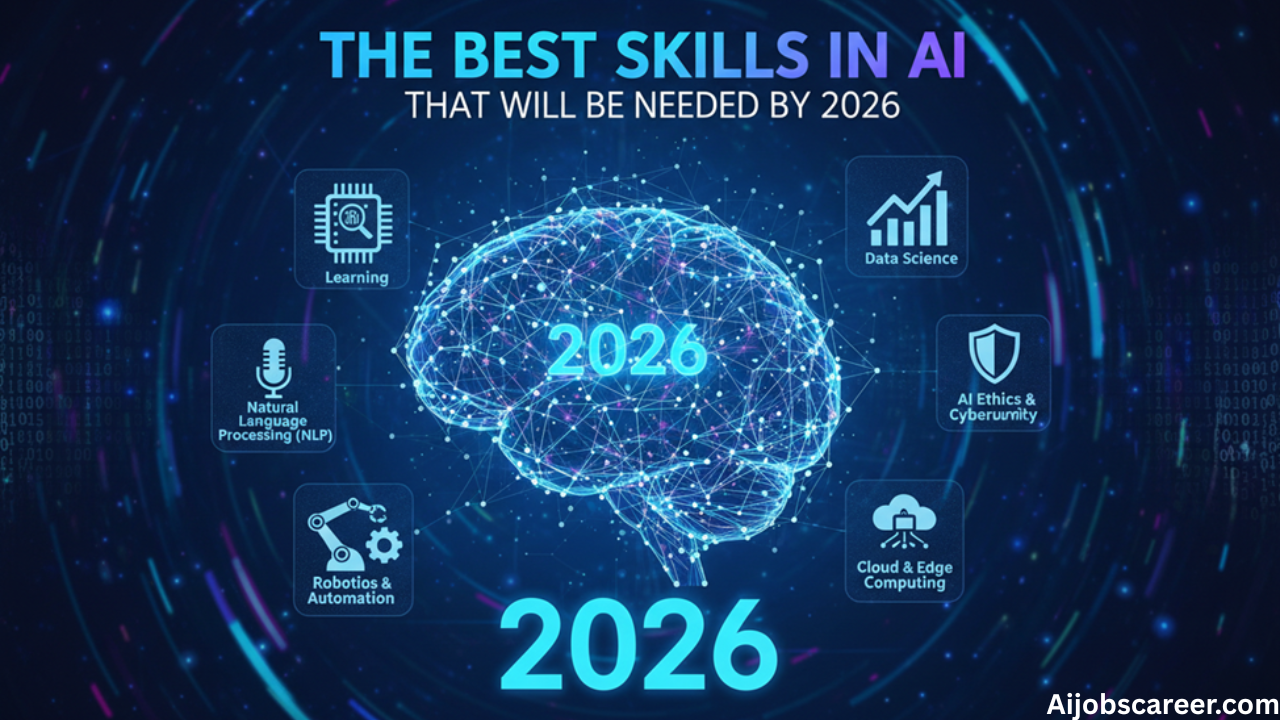
Introduction: The 2026 Skills of AI Dominate the Job Market
Artificial Intelligence is no longer an experimental technology. It is now an engine of the business in healthcare, finance, e-commerce, education, cybersecurity, and manufacturing, to name a few. Businesses are not only implementing AI solutions; they are also reorganizing teams based on AI-driven solutions.
Consequently, the hiring managers are on the hunt to find professionals able to develop, operate, and strategically deploy AI solutions. The demand is not limited to a simple knowledge of code. Employers seek people who will know how AI generates quantifiable business value.
Machine Learning: the Backbone of Modern AI
Machine Learning will also remain among the most sought-after AI skills in 2026. It is the foundation of predictive analytics, recommendation systems, fraud detection systems, and automation systems. Firms are recruiting Machine Learning Engineers who are able to create supervised and unsupervised models, optimize algorithms and use deep learning frameworks like TensorFlow and PyTorch.
Good Python programming experience, experience in data preprocessing, and model performance evaluation are essential. Company owners appreciate individuals with the ability to transform theoretical frameworks into practical applications that are replicable to real world.
Generative AI and Large Language Models
Generative AI has changed the way companies do things. Large Language Models (LLMs) are being deployed to workflows and automated content generation as well as AI-driven customer service by companies. By 2026, there will be a high demand of professionals knowledgeable in how to operate with the generative AI tools, how to design effective prompts and how to integrate AI APIs into the business systems.
Prompt engineering, response optimization, and AI workflow automation are a few of the skills that have a direct effect on productivity. Organisations like to hire people who are responsible in the use of generative AI yet ensure the accuracy and relevance of outputs.
Information Technology, Data Science, and Advanced Analytics
AI systems are data driven, and that is why Data Science is a very crucial skill. Instead, organizations require professionals capable of cleaning, analyzing, and interpreting big data to aid in AI-driven decisions. To a high degree, the competence in statistics, SQL, Python, R, and data visualization tools are all appreciated. In addition to the technical skills, firms seek data experts capable of conveying wisdom and assisting the leadership to make sound strategic decisions. The ability to think using data has become a standard in AI-oriented jobs.
Natural Language Processing (NLP)
NLP is expanding with the business investing in conversational AI and smart automation. NLP helps machines to read and write human language, which drives chatbots, sentiment analysis applications, and voice assistants. In 2026, firms are in need of experts familiar with transformer-based models, text classification methods, and language generation systems. With more and more customer communication depending on AI communication systems, NLP knowledge has become a niche yet a highly useful skill.
MLOps and AI Deployment
The construction of an AI model is not everything, and implementing it and keeping it is also a crucial aspect of the task. Machine Learning Operations (MLOps) is concerned with the operations of AI systems in a production context.
The firms are recruiting specialists who are conversant with CI/CD pipelines, containerization technologies such as Docker, orchestration systems such as Kubernetes, and cloud-deployment approaches. Employers need AI systems that can be scaled, secure, and continually monitored in terms of performance. There is a high demand among professionals able to make sure that the model can be reliable in the long run.
Scalable Infrastructure, Cloud Computing
The current AI systems mostly work on the clouds. Experience in Amazon Web Services (AWS), Microsoft Azure, and Google Cloud is also very useful in 2026. Organizations are more likely to hire people who are capable of developing scalable AI structures, administering dispensed computing frameworks and streamlining the cost of infrastructure.
Cloud experience enables companies to manipulate large data and intricate model training tasks effectively. A combination of AI skills and cloud knowledge has a great impact on employability.
AI-Powered Cybersecurity
Since AI systems have sensitive data, cybersecurity is now a primary concern. Firms are recruiting experts on how to protect AI infrastructure, identify weaknesses and avert cyber attacks. There is also the application of AI to reinforce security systems by automated detection of threats and risk analysis. Cybersecurity practitioners who integrate AI expertise and principles can be of immeasurable value to the companies in the highly regulated business environment.
Artificial Intelligence Product Integration and Development
Companies desire AI to be directly incorporated into its products and services. This has raised the level of requirements of professionals who are able to incorporate AI APIs in applications, create easy to use AI features and work in cross-functional teams. The experience in the art of user experience design, knowledge of backend systems and product testing are all highly appreciated. Businesses seek individuals capable of turning AI capabilities into real-life solutions that will improve customer experience and operational efficiency.
Soft Skills and Ethical AI Perception
In 2026, technical skills are not sufficient. Employers put more emphasis on professionals with the ability to think critically, prepare other people with complex problems and communicate effectively.
The ethical AI knowledge has gained significance especially now that AI systems inform employment, fiscal grants, and medical prescriptions. Businesses are seeking people who are aware of the mitigation of bias, principles of fairness, and responsible development of AI. Technical expertise cannot do without human judgment.
Conclusion
The highest demanded AI skills in 2026 include the change in practical, scalable and responsible AI application. Whether it is Machine Learning and Generative AI or cloud infrastructure and cybersecurity, businesses are recruiting experts who may be equally skilled experts and business-sensitive.
As the job market moves toward those who never give up on learning, keeping with the new technological advancements, and are committed to impacting the lives of others, this is a fair assumption. Through acquiring such skills that are highly sought after, the professionals will be able to have good career opportunities in the fast-changing AI environment.