
AI career Paths: Robotics, Skills, Coursework, and Job description
Introduction
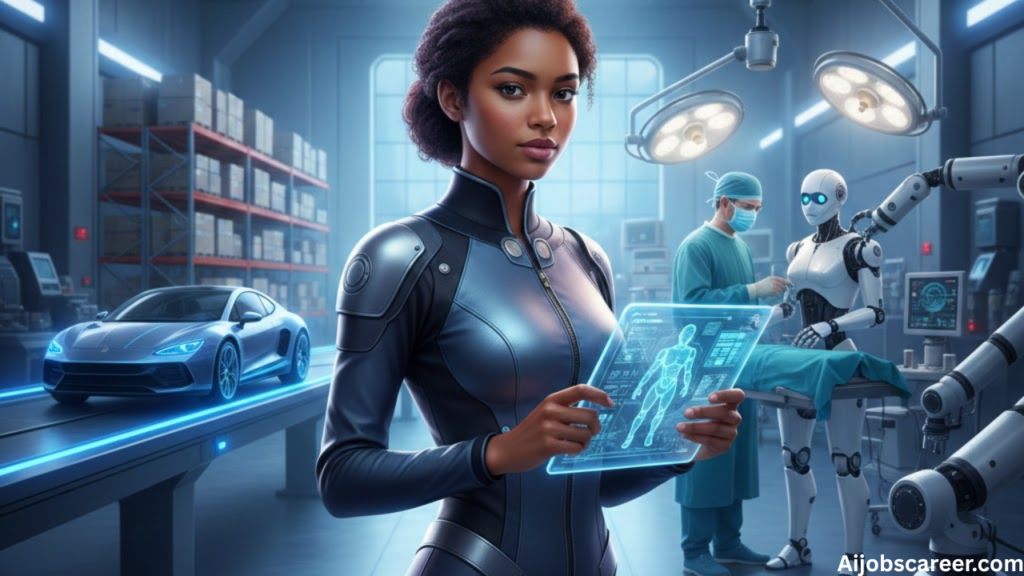
The world is in a reshaping of industries as a result of robotics and Artificial Intelligence (AI career). Since self-driving cars, warehouse automation, humanoid robots and medical robotics, Robotics + AI is forming one of the most thrilling and most rapidly growing career paths in 2026 and beyond.
A career as a Robotics AI is the right career to choose in case you are willing to develop intelligent robots that can see, think and do. Here, we are going to discuss what skills are required, good courses and the scope of the job.
What is Robotics AI?
Robotics AI can be defined as the fact that Artificial Intelligence methods are implemented into robots. Conventional robots are directed by instructions. Nevertheless, AI-controlled robots have the ability to learn and work based on the information, identify trends, take decisions and fit well in the new environment.
For example:
- The AI robots in the manufacturing industry are used to identify faults.
- Autopilot cars rely on AI to navigate.
- Complex surgery is supported with the help of medical robots.
- Natural Language Processing is used by service robots to communicate with human beings.
It is a discipline that is a blend of mechanical engineering, electronics, computer science, and machine learning.
What is the Reason to Make Robotics AI a Career in 2026?
Robotics AI career is viewed as a future-proof and high-paying sector since automation is spreading very fast in industries. Smart robotics systems are being implemented in manufacturing, health care, logistics, defense, space research, agriculture, and even retail.
The cost of robotics research and AI development is intense among governments and individual companies. Automation and Industry 4.0 have become the focus of such countries as the US, Germany, Japan, China, and India.
Robotics AI careerprofessionals also earn [?]6-12 LPA in entry-level positions in India, whereas experienced engineers earn [?]20-40 LPA or higher. Salaries may vary between $90,000-160,000 per year in various parts of the world varying on experience and specialization.
Educational Qualification is necessary
To join Robotics AI, one will usually require a degree in:
- Computer Science Engineering.
- Machine Learning and Artificial Intelligence.
- Robotics Engineering
- Electronics & Communication
- Mechanical Engineering
- Mechatronics
Nonetheless, self-educated learners can also get into AI career profession with good practical skills and projects.
A good background in math is desirable, such as:
- Linear Algebra
- Calculus
- Probability & Statistics
Machine learning and robotics control systems need these concepts.
Basic competencies needed in a Robotics AI Career
- Programming Skills
Robotics is based on programming. You should learn:
- Python (for AI and ML) best AI career
- C++ (commonly used in robotics systems) for AI career
- ROS (Robot Operating System) for AI career
- MATLAB (for simulations) for AI career
AI algorithms are written in Python and performance-critical robotics applications are typically written in C++.
- Machine Learning and Artificial Intelligence
Robots are able to make intelligent decisions with the help of AI. Important topics include:
- Machine learning algorithms.
- Computer Vision
- Deep Learning
- Reinforcement Learning
- Natural Language Processing
Computer Vision is particularly significant since cameras and sensors help robots to know what is around them.
- Robotics Fundamentals best for AI career
You have to know the fundamentals of robotics, including:
- Kinematics and dynamics
- Control systems
- Embedded systems
- Sensors and actuators
- Microcontrollers (Arduino, Raspberry Pi)
The integration of hardware and software is an important concept that should be understood in Robotics AI.
- Electronics and Embedded Systems
Hardware control is associated with robotics. Basic knowledge of:
- Circuit design
- IoT systems
- Signal processing
- PCB basics
will be a great advantage to you.
Top robotics AI courses to begin my career
Robotics AI can be taught online and through certification. Examples of popular learning options are:
- Artificial Intelligence and Machine Learning (Coursera, Udemy)
- IT courses in IITs, NPTEL, or edX.
- ROS certification programs
- Embedded systems training
- Computer Vision bootcamps
Where feasible, take internships at robotics laboratories, start-ups or automation firms. Practical experience is more important than certificates.
The AI Career Roadmap of Step-by-Step Robotics
Step 1: Establish Programming Base
Start with Python and C++. Do simple coding exercises.
Step 2: Master AI andMachine Learning
Research ML algorithms, neural networks, and computer vision. Build small AI models.
Step 3: Be familiar with Robotics Systems
Get to know about sensors, actuators, and robot control systems. Arduino or Raspberry Pi.
Step 4: Work with ROS
ROS is popular in the development of robots. Development Projects Build projects with ROS simulation.
Step 5: Develop Real World Projects
Create projects like:
- Obstacle-avoiding robot
- Face recognition robot
- Line-following AI robot
- Self-balancing robot
Post projects in GitHub and publish them in your portfolio.
Job Roles in Robotics AI
Once you have the skills, you can take jobs in the following roles:
- Robotics Engineer
- AI Robotics Engineer
- Machine Learning Engineer (Robotics division)
- Computer Vision Engineer
- Automation Engineer
- Cybernetic Systems Engineer.
- Embedded AI Engineer
Experience will help you to become a senior position such as Robotics Architect, AI Systems Lead, or R&D Head.
Robotics AI Professionals are employed in industries
AI experts in robotics are required in:
- Automation and manufacturing.
- Healthcare Robotics
- Defense and Aerospace
- Autopilot car firms.
- Logistics and Warehousing
- Agriculture automation
- Space research institutions.
The companies that are aggressively recruiting in the area of drone technology, warehouse robotics, and AI-based automation are also startups.
Future Scope of Robotics AI
The future of AI in Robotics is very powerful. The development of Generative AI, reinforcement, and edge computing makes robots smarter and more autonomous.
Humanoid robots, robotic surgeries, AI-controlled warehouses, and drones with AIs are spreading very fast. Robotics AI will also continue to increase as businesses strive to minimize human error and maximize efficiency.
According to experts, millions of new jobs will be generated around the world by the automation of robotics.
Final Thoughts
Robotics AI has a promising career, high remuneration, development, and a worldwide presence. It is demanding, technical, and has to be practiced. This is also one of the most exciting tech jobs to take in 2026 in case you are passionate about building intelligent machines and going to solve some problems in the real world.
Begin with a programming course, learn the basics of AI, become familiar with the principles of robotics, and create projects continuously. It will be possible to make yourself in this future-ready and in-demand sector with hard work.
Introduction
The world is in a reshaping of industries as a result of robotics and Artificial Intelligence. Since self-driving cars, warehouse automation, humanoid robots and medical robotics, Robotics + AI is forming one of the most thrilling and most rapidly growing career paths in 2026 and beyond.
A career as a Robotics AI is the right career to choose in case you are willing to develop intelligent robots that can see, think and do. Here, we are going to discuss what skills are required, good courses and the scope of the job.
What is Robotics AI?
Robotics AI can be defined as the fact that Artificial Intelligence methods are implemented into robots. Conventional robots are directed by instructions. Nevertheless, AI-controlled robots have the ability to learn and work based on the information, identify trends, take decisions and fit well in the new environment.
For example:
- The AI robots in the manufacturing industry are used to identify faults.
- Autopilot cars rely on AI to navigate.
- Complex surgery is supported with the help of medical robots.
- Natural Language Processing is used by service robots to communicate with human beings.
It is a discipline that is a blend of mechanical engineering, electronics, computer science, and machine learning.
What is the Reason to Make Robotics AI a Career in 2026?
Robotics AI is viewed as a future-proof and high-paying sector since automation is spreading very fast in industries. Smart robotics systems are being implemented in manufacturing, health care, logistics, defense, space research, agriculture, and even retail.
The cost of robotics research and AI development is intense among governments and individual companies. Automation and Industry 4.0 have become the focus of such countries as the US, Germany, Japan, China, and India.
Robotics AI professionals also earn [?]6-12 LPA in entry-level positions in India, whereas experienced engineers earn [?]20-40 LPA or higher. Salaries may vary between $90,000-160,000 per year in various parts of the world varying on experience and specialization.
Educational Qualification is necessary
To join Robotics AI, one will usually require a degree in:
- Computer Science Engineering.
- Machine Learning and Artificial Intelligence.
- Robotics Engineering
- Electronics & Communication
- Mechanical Engineering
- Mechatronics
Nonetheless, self-educated learners can also get into this profession with good practical skills and projects.
A good background in math is desirable, such as:
- Linear Algebra
- Calculus
- Probability & Statistics
Machine learning and robotics control systems need these concepts.
Basic competencies needed in a Robotics AI Career
- Programming Skills
Robotics is based on programming. You should learn:
- Python (for AI and ML)
- C++ (commonly used in robotics systems)
- ROS (Robot Operating System)
- MATLAB (for simulations)
AI algorithms are written in Python and performance-critical robotics applications are typically written in C++.
- Machine Learning and Artificial Intelligence
Robots are able to make intelligent decisions with the help of AI. Important topics include:
- Machine learning algorithms.
- Computer Vision
- Deep Learning
- Reinforcement Learning
- Natural Language Processing
Computer Vision is particularly significant since cameras and sensors help robots to know what is around them.
- Robotics Fundamentals
You have to know the fundamentals of robotics, including:
- Kinematics and dynamics
- Control systems
- Embedded systems
- Sensors and actuators
- Microcontrollers (Arduino, Raspberry Pi)
The integration of hardware and software is an important concept that should be understood in Robotics AI.
- Electronics and Embedded Systems
Hardware control is associated with robotics. Basic knowledge of:
- Circuit design
- IoT systems
- Signal processing
- PCB basics
will be a great advantage to you.
Top robotics AI courses to begin my career
Robotics AI can be taught online and through certification. Examples of popular learning options are:
- Artificial Intelligence and Machine Learning (Coursera, Udemy)
- IT courses in IITs, NPTEL, or edX.
- ROS certification programs
- Embedded systems training
- Computer Vision bootcamps
Where feasible, take internships at robotics laboratories, start-ups or automation firms. Practical experience is more important than certificates.
The AI Career Roadmap of Step-by-Step Robotics
Step 1: Establish Programming Base
Start with Python and C++. Do simple coding exercises.
Step 2: Master AI andMachine Learning
Research ML algorithms, neural networks, and computer vision. Build small AI models.
Step 3: Be familiar with Robotics Systems
Get to know about sensors, actuators, and robot control systems. Arduino or Raspberry Pi.
Step 4: Work with ROS
ROS is popular in the development of robots. Development Projects Build projects with ROS simulation.
Step 5: Develop Real World Projects
Create projects like:
- Obstacle-avoiding robot
- Face recognition robot
- Line-following AI robot
- Self-balancing robot
Post projects in GitHub and publish them in your portfolio.
Job Roles in Robotics AI
Once you have the skills, you can take jobs in the following roles:
- Robotics Engineer
- AI Robotics Engineer
- Machine Learning Engineer (Robotics division)
- Computer Vision Engineer
- Automation Engineer
- Cybernetic Systems Engineer.
- Embedded AI Engineer
Experience will help you to become a senior position such as Robotics Architect, AI Systems Lead, or R&D Head.
Robotics AI Professionals are employed in industries
AI experts in robotics are required in:
- Automation and manufacturing.
- Healthcare Robotics
- Defense and Aerospace
- Autopilot car firms.
- Logistics and Warehousing
- Agriculture automation
- Space research institutions.
The companies that are aggressively recruiting in the area of drone technology, warehouse robotics, and AI-based automation are also startups.
Future Scope of Robotics AI
The future of AI in Robotics is very powerful. The development of Generative AI, reinforcement, and edge computing makes robots smarter and more autonomous.
Humanoid robots, robotic surgeries, AI-controlled warehouses, and drones with AIs are spreading very fast. Robotics AI will also continue to increase as businesses strive to minimize human error and maximize efficiency.
According to experts, millions of new jobs will be generated around the world by the automation of robotics.
Final Thoughts
Robotics AI has a promising career, high remuneration, development, and a worldwide presence. It is demanding, technical, and has to be practiced. This is also one of the most exciting tech jobs to take in 2026 in case you are passionate about building intelligent machines and going to solve some problems in the real world.
Begin with a programming course, learn the basics of AI, become familiar with the principles of robotics, and create projects continuously. It will be possible to make yourself in this future-ready and in-demand sector with hard work.