
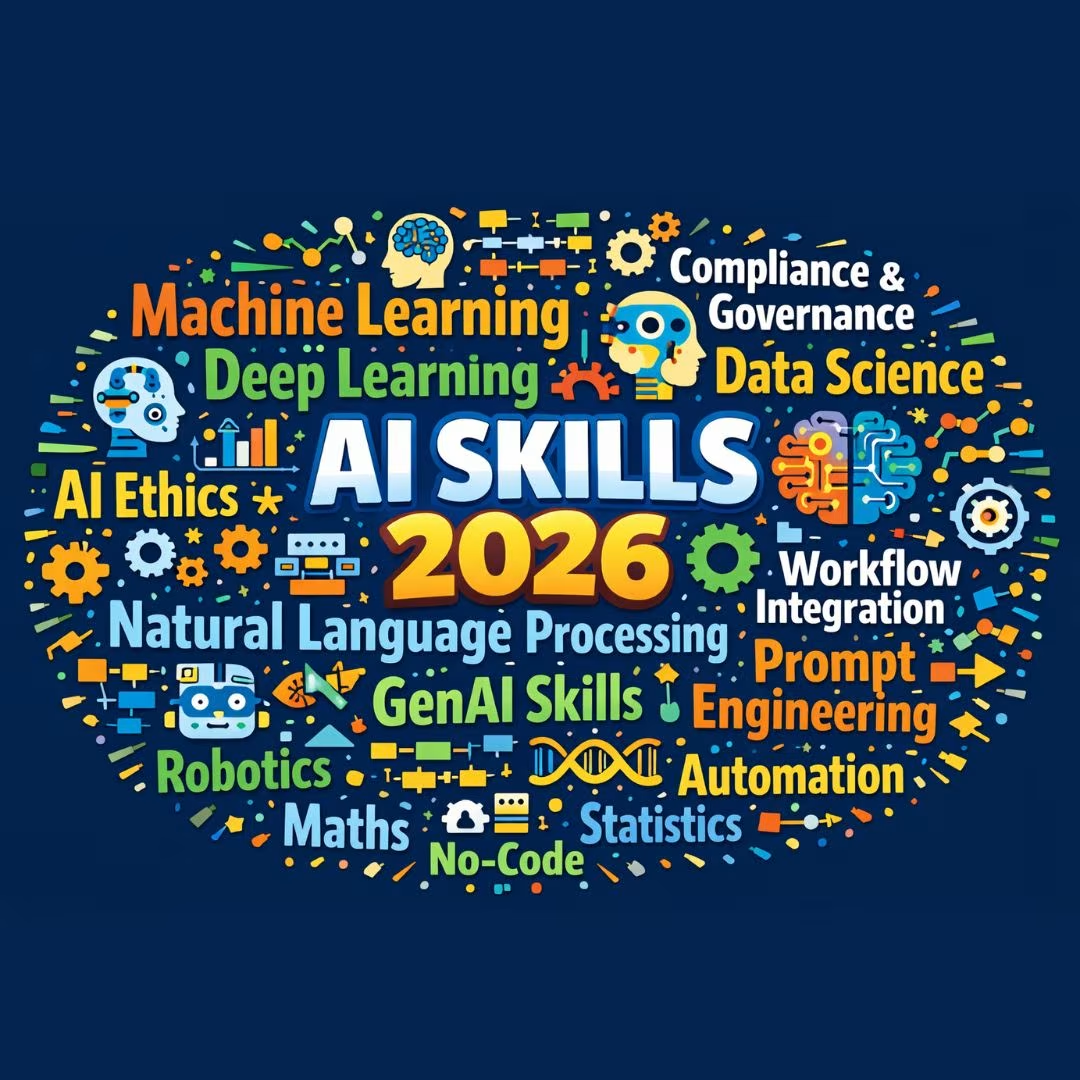
AI skills are becoming important across technology, business, education and other professional fields as organizations adopt artificial intelligence for tasks ranging from data analysis to software development and automation. The skills required range from basic AI literacy and prompt writing to machine learning, data engineering, AI application development and responsible AI practices.
AI skills are not limited to professionals who build AI models. People working in marketing, finance, operations, human resources, customer service and other fields can use AI tools to improve existing workflows while learning how to evaluate their results.
What Are AI Skills?
AI skills are the knowledge and abilities needed to understand, use, build, evaluate or manage artificial intelligence systems. They include technical capabilities such as programming and machine learning as well as practical abilities such as writing effective prompts, checking AI outputs and identifying suitable business applications.
The required level of expertise depends on the career. Someone using an AI assistant for research needs a different skill set from a machine-learning engineer developing and deploying AI models.
AI Literacy
AI literacy is the foundation for most beginners. It includes understanding what AI and generative AI can do, how large language models work at a basic level, where AI systems can make mistakes and how to use them responsibly.
AI literacy also means recognizing inaccurate or unsupported AI-generated information. Users should understand when human review is necessary and avoid treating generated content as automatically correct.
Prompt Engineering
Prompt engineering involves creating clear instructions that help AI systems produce useful results. Effective prompts can provide context, define the required format, establish constraints and explain the intended objective.
Prompt skills can be useful for writing, research, coding, analysis and many other tasks. However, prompt writing is only one part of effective AI use because users still need to evaluate and edit the results.
Data Skills
Data is central to many AI systems. Professionals working with AI can benefit from understanding spreadsheets, databases, statistics, data cleaning and data visualization.
More technical roles may require SQL, Python, data engineering, machine-learning datasets and methods for evaluating data quality. Strong data skills can help professionals identify problems before they reach an AI model or application.
Programming and Machine Learning
People pursuing technical AI careers commonly learn Python along with algorithms, statistics and machine-learning concepts. They can then move into supervised learning, unsupervised learning, deep learning and model evaluation.
Specialized careers may require knowledge of natural-language processing, computer vision, recommendation systems, generative AI and large language models.
Generative AI and LLM Skills
Generative AI skills include working with systems that create text, images, audio, video or code. Professionals may need to understand model capabilities, context management, retrieval-augmented generation, APIs and methods for evaluating generated results.
For application developers, additional skills can include vector databases, embeddings, tool calling and AI agent frameworks. These technologies allow AI applications to work with external information and software systems.
AI Automation
AI automation combines artificial intelligence with business workflows. Professionals can use AI to classify information, summarize documents, respond to routine requests, extract data or coordinate multiple steps in a process.
Automation requires more than selecting an AI tool. Users need to understand the existing workflow, identify suitable automation points, establish quality checks and determine where human approval should remain.
Responsible AI Skills
Responsible AI includes understanding privacy, security, bias, transparency, copyright and risks associated with automated decisions. Organizations may require employees to follow internal policies and applicable regulations when using AI.
Professionals who build AI systems also need methods for testing, monitoring and documenting model behavior. Governance and risk-management skills are becoming increasingly relevant as AI is introduced into business-critical processes.
Human Skills Still Matter
AI skills work alongside communication, analytical thinking, creativity, problem-solving and collaboration. The World Economic Forum’s Future of Jobs Report 2025 identifies analytical thinking as a leading core skill among employers and lists AI and big data among the fastest-growing skill areas through 2030.
Human judgment is especially important when AI produces uncertain or incorrect results. Professionals need to decide when an AI output is useful, when it requires verification and when a task should remain under direct human control.
How to Learn AI Skills
Beginners can start with AI fundamentals and everyday AI tools before choosing a specialization. Practical exercises help learners understand how AI behaves in real situations and identify problems such as inaccurate information or inconsistent results.
Technical learners can progress from Python and data fundamentals into machine learning, generative AI and AI application development. Non-technical professionals can focus on AI literacy, workflow automation and applying AI to their existing industry expertise.
Building projects can strengthen the learning process. Examples include an AI research assistant, document-analysis workflow, customer-support prototype, data-analysis project or automated business process.
AI Skills and Career Growth
AI skills can support both new careers and existing professions. Technical positions include AI engineer, machine-learning engineer, data scientist, AI application developer and MLOps specialist, while non-technical opportunities include AI product management, AI consulting, automation and AI-enabled business operations.
The most useful combination of skills depends on an individual’s career goals. AI literacy provides a starting point, while deeper technical, business or domain expertise can support more specialized opportunities.
As AI tools and workplace applications continue to change, learning AI is becoming an ongoing process rather than a one-time qualification. Combining practical AI knowledge with domain expertise, critical thinking and responsible use provides a foundation for adapting as the technology develops.