
Generative AI research is expanding rapidly in 2026, creating demand for scientists who understand machine learning theory, large language models, multimodal systems, AI agents, model evaluation, and research methodology. Becoming a generative AI scientist requires more than learning AI tools; it requires the ability to understand models, design experiments, analyze results, and develop new approaches.
Build a Strong Mathematics Foundation
Start with linear algebra, probability, statistics, calculus, and optimization. These subjects help explain how neural networks learn, how models represent information, and how training algorithms improve model performance.
Master Python and Machine Learning
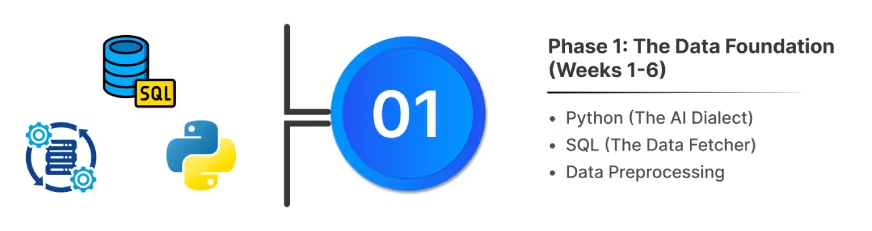
Python should be the primary programming language for an AI research career. Learn machine learning fundamentals including supervised learning, unsupervised learning, model evaluation, feature engineering, optimization, and statistical learning.
Learn Deep Learning
The next step is understanding neural networks, backpropagation, embeddings, attention mechanisms, and modern training techniques. Practical experience with frameworks such as PyTorch can help turn theoretical knowledge into working experiments.
Understand Generative AI Models
A 2026 roadmap should cover transformer architectures, large language models, diffusion models, multimodal models, retrieval-augmented generation, fine-tuning, and AI agents. Understanding how these systems are trained and evaluated is more valuable for research than simply learning how to operate them.
Study Large Language Models
Learn tokenization, embeddings, attention, pretraining, supervised fine-tuning, preference optimization, inference, context management, and model evaluation. Experimenting with open-source models can provide practical experience with the full development process.
Explore Multimodal and Agentic AI
Generative AI increasingly combines text with images, audio, video, and other data types. AI agents also connect models with tools, external information, memory, and software environments. These areas offer important research opportunities for scientists entering the field.
Develop Research Skills
AI scientists need to read academic papers, identify research gaps, reproduce published experiments, design controlled studies, analyze results, and communicate findings clearly. Reproducing an important research paper is a strong early project because it teaches the complete research workflow.
Focus on Evaluation and Reliability
Generative AI systems can produce incorrect, biased, unsafe, or inconsistent results. Researchers therefore need to understand benchmarking, hallucination detection, robustness testing, bias evaluation, safety testing, and statistical analysis. Tools such as CheckAIContent can also be useful when evaluating AI-generated text and studying content authenticity.
Build a Research Portfolio
A strong portfolio should demonstrate experimentation rather than only API usage. Useful projects include fine-tuning an open model, comparing retrieval strategies, evaluating different prompting methods, reproducing a published result, creating an AI benchmark, or investigating model efficiency and safety.
Choose a Specialization
After developing broad foundations, researchers can specialize in areas such as LLMs, multimodal AI, AI agents, reasoning models, diffusion models, model efficiency, AI safety, evaluation, robotics, or machine learning systems.
Develop Communication and Critical Thinking
Research requires more than technical knowledge. Scientists must question results, identify weaknesses in experiments, interpret evidence, explain complex findings, and collaborate with other researchers and engineers. Strong scientific communication can become an important career advantage.
2026 Learning Path
A practical sequence is mathematics and Python, followed by machine learning and deep learning, then transformers and generative models, followed by LLMs, multimodal AI, RAG and agents. The final stage should focus on research projects, paper reproduction, original experiments, and specialization.
Latest Status
Generative AI research in 2026 is moving toward increasingly capable multimodal, reasoning, and agentic systems. For aspiring AI scientists, the strongest preparation combines mathematical foundations, programming, deep learning, hands-on experimentation, rigorous evaluation, and the ability to conduct independent research.