
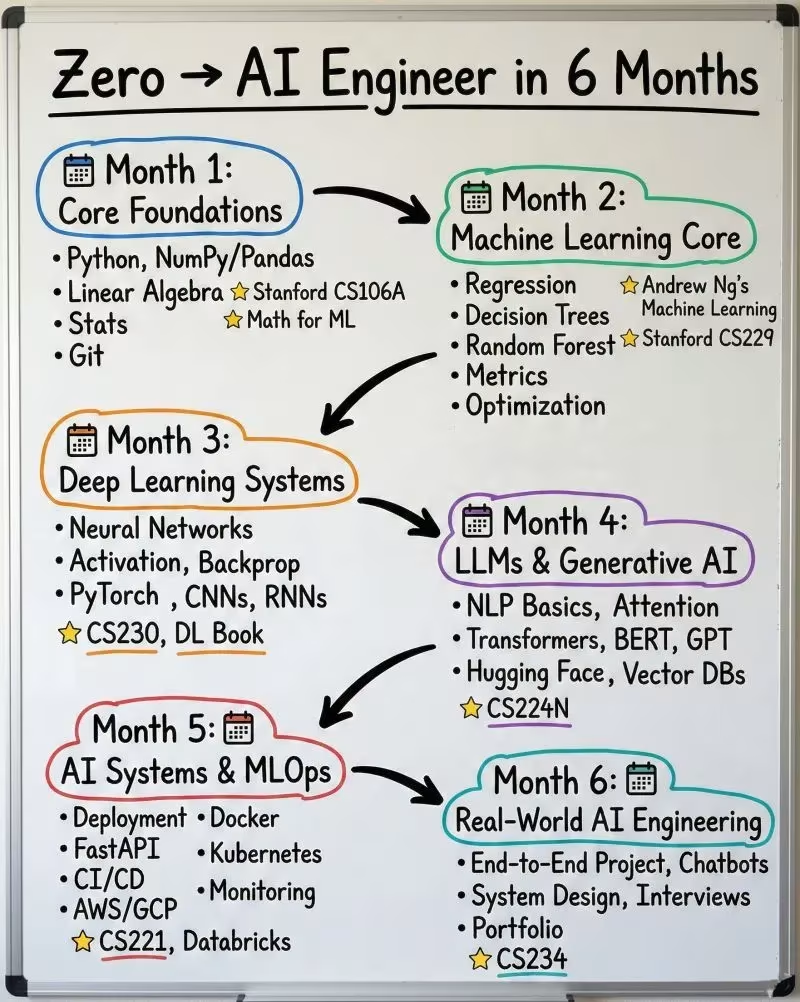
Becoming an artificial intelligence engineer in six months is a possible goal for learners who follow a structured plan, practise coding regularly and build working projects. The timeline depends on prior programming experience, study hours and the type of AI role being targeted.
AI engineering combines software development, machine learning, data handling and the integration of AI models into applications. Programming, data science, software engineering and model evaluation are important areas for people preparing for the profession.
A six-month plan can help learners move from programming fundamentals to machine learning, generative AI and application deployment. However, completing a roadmap does not guarantee employment, particularly for people starting without coding experience.
Month 1: Learn Python and Programming Fundamentals
The first month should focus on Python, one of the main programming languages used in AI development. Beginners need to understand variables, data types, loops, functions, lists, dictionaries, error handling and working with files.
Git and GitHub are also useful early skills. They allow developers to track code changes, manage projects and share their work with employers or collaborators.
Learners should practise writing small programs rather than relying only on video lessons. Examples include a calculator, a text-processing tool and a program that reads and organises information from a file.
Basic knowledge of SQL, HTTP requests and JSON can provide a foundation for later projects. These skills become important when AI applications need to retrieve information from databases or communicate with external services.
Month 2: Understand Data and Machine Learning
The second month introduces machine learning, including how systems learn patterns from data and use those patterns to make predictions. Learners should study supervised and unsupervised learning, training and testing datasets, classification, regression and clustering.
Python libraries such as NumPy, pandas and scikit-learn help developers work with datasets and build introductory machine-learning models. Learners should also understand accuracy, precision, recall and other measures used to assess model performance.
Google’s Machine Learning Crash Course provides lessons, interactive visualisations and practical exercises. Its recommended preparation includes Python programming, NumPy, pandas, basic algebra and introductory statistics.
A suitable project for this stage is a prediction model using a public dataset. A learner might build a system that estimates house prices or classifies customer feedback, then test its performance on data that was not used during training.
Month 3: Explore Deep Learning
The third month can focus on deep learning, which uses neural networks to identify complex patterns in data. Important concepts include layers, activation functions, loss functions, optimisation and backpropagation.
Learners can begin experimenting with frameworks such as PyTorch or TensorFlow after understanding basic machine-learning concepts. The goal is to learn how to train, evaluate and use a model rather than attempt to master every advanced technique at once.
Practical exercises might include image classification, sentiment analysis or a simple text classifier. These projects help learners understand how data preparation, model selection and evaluation affect results.
Mathematics remains useful throughout this stage. A working understanding of vectors, matrices, probability, statistics and derivatives can help explain how neural networks operate, while research-focused roles may require deeper mathematical knowledge.
Month 4: Build Applications with Generative AI
The fourth month introduces large language models and generative AI applications. Learners should understand prompts, tokens, context windows, model APIs, structured outputs and the limitations of generated responses.
Instead of training a large language model from scratch, beginners can use an existing model through an application programming interface. This approach makes it possible to focus on building useful software and understanding how models behave in real applications.
One project could be a document question-answering tool that lets users ask questions about uploaded files. Another could summarise long documents or organise customer feedback into categories.
Retrieval-augmented generation, commonly known as RAG, is another important topic. It combines information retrieval with language-model responses, allowing an application to consult relevant documents before generating an answer.
Developers should also learn to identify hallucinations, protect sensitive information and evaluate whether generated responses are accurate. These checks are important when applications are used for education, business or other information-sensitive tasks.
Month 5: Learn Deployment and Production Skills
Building a model or chatbot is only one part of AI engineering. The fifth month should focus on making an application accessible, reliable and easier to maintain.
FastAPI can be used to create Python-based application programming interfaces, while Docker helps package software and its dependencies. Learners can also explore cloud hosting, environment variables, authentication, logging and basic automated testing.
AI applications require additional checks beyond conventional software testing. Developers should measure response quality, latency and usage costs, and test how the system behaves when users submit unclear questions or unexpected inputs.
For a RAG application, testing should examine whether the system retrieves relevant documents and whether its answers are supported by those documents. A working application with clear documentation provides stronger evidence of practical ability than a project that exists only as a tutorial exercise.
Month 6: Complete a Portfolio Project and Prepare for Jobs
The final month should bring the earlier skills together in one substantial project. Examples include a research assistant that searches documents, a customer-support assistant grounded in company information or an AI tool that analyses and categorises text.
The finished application should have a clear purpose, a usable interface or API, reliable error handling and a documented setup process. Where possible, learners should deploy it and provide a public demonstration alongside the source code.
A strong portfolio should explain the problem being solved, the technologies used, the design decisions made and the limitations discovered during testing. Including evaluation results helps demonstrate that the project was assessed rather than simply built to produce an impressive demonstration.
Job preparation should happen alongside project development. Candidates can review entry-level AI engineer, machine-learning engineer and software engineer roles to identify common requirements, practise Python coding questions and prepare to explain their projects during technical interviews.
How Much Time Should Learners Set Aside?
The amount of time available each week can significantly affect the six-month target. A learner who already writes software may progress faster than someone who must first learn programming, databases and basic mathematics.
A balanced schedule should combine lessons, coding exercises, project work and review. Learners should also leave time to revisit difficult concepts instead of moving forward simply because a calendar milestone has arrived.
Choose the Right AI Engineering Path
The term AI engineer covers several different kinds of work. Some professionals build applications around existing language models, while others develop machine-learning pipelines, train models or conduct research into new techniques.
People interested in generative AI applications should prioritise Python, APIs, retrieval systems, evaluation and deployment. Those targeting traditional machine-learning roles should spend more time on statistics, feature engineering, model evaluation and data pipelines.
Research-focused positions often require stronger mathematics, deeper knowledge of model architectures and substantial experimental experience. A six-month beginner roadmap is therefore better understood as a starting point than a complete preparation plan for every AI career.
Resources for Continued Learning
Google’s Machine Learning Crash Course offers a practical introduction to core machine-learning concepts, while Microsoft Learn provides training resources for aspiring AI engineers. These resources can be combined with programming practice, open datasets and independent projects.
By the end of six months, a learner following a consistent plan should aim to understand the fundamentals, build and evaluate AI-powered applications, deploy at least one substantial project and explain the technical choices behind it. The next step is to use that work to identify skill gaps, seek internships or junior opportunities and continue learning as AI development tools evolve.
As of October 2026, six months remains a useful planning horizon for structured AI engineering study, but the outcome depends on the learner’s starting point and the depth of practical experience gained. Employers will assess demonstrated skills and role-specific knowledge rather than the length of a study plan alone.