
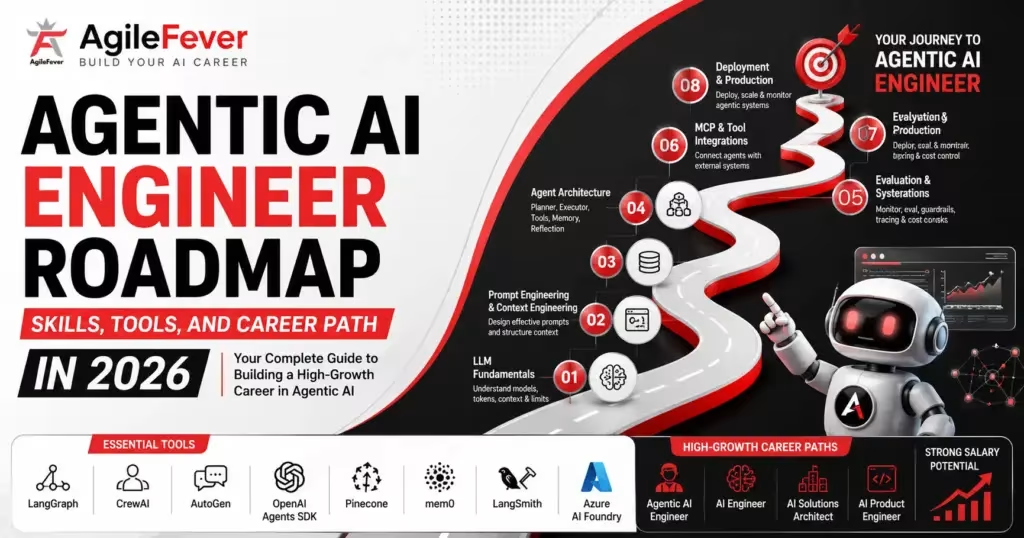
Agentic AI engineering is becoming an important specialization as businesses explore AI systems that can plan tasks, use tools and complete multistep workflows with limited human intervention. In 2026, aspiring engineers need a combination of programming knowledge, AI fundamentals, system integration skills and practical experience building reliable AI agents.
What Is an Agentic AI Engineer?
An agentic AI engineer designs and develops AI-powered systems that work toward defined goals, select appropriate actions and interact with external tools. Unlike a basic chatbot that primarily responds to prompts, an AI agent may execute multiple steps, search databases, use APIs and request human approval when necessary.
These systems can support customer service, software development, research, data analysis and business process automation. Their effectiveness depends on how well engineers design workflows, manage context and prevent errors.
Step 1: Learn Python and Software Development
Python is a useful starting point because it is widely used in AI development, automation and data processing. Learn variables, functions, classes, asynchronous programming, exception handling and package management.
Also develop practical knowledge of Git, command-line tools, REST APIs, HTTP requests and JSON. These skills help connect AI models with databases, business applications and external services.
Step 2: Understand Large Language Models
Learn how large language models process prompts, generate responses and work with context windows. Important concepts include token limits, structured outputs, embeddings, prompt design and model limitations.
Retrieval-augmented generation, or RAG, is another essential concept. It enables an AI application to retrieve relevant information from external documents or databases before generating a response.
Step 3: Explore Agent Frameworks
Frameworks help developers build and manage agent workflows. Tools worth exploring include LangGraph, LangChain, LlamaIndex and Microsoft Agent Framework. Each offers different capabilities for orchestration, tool integration and workflow management.
Learn to choose frameworks according to project requirements. A straightforward workflow with clearly defined steps can be more reliable and easier to maintain than a complicated system with multiple autonomous agents.
Step 4: Master Tool Calling and Automation
Tool calling allows an AI model to request actions through approved functions or APIs. Examples include searching a knowledge base, retrieving customer information, querying a database or creating a support ticket.
Engineers should learn input validation, authentication, error handling and permission management. Automation platforms such as n8n and Zapier can help connect AI workflows with business applications.
Step 5: Learn Memory and Multi-Agent Systems
Some AI agents maintain information across several steps or retrieve details from previous interactions. Developers should understand the differences between conversation history, temporary workflow state and persistent memory stored in external systems.
Multi-agent architectures divide work among specialised components. Although this can help with certain complex tasks, it may also increase costs, coordination challenges and debugging requirements.
Step 6: Focus on Evaluation and Security
Successful demonstrations do not automatically translate into reliable production systems. Engineers should test task completion, factual accuracy, tool-use correctness, response time and operating costs. Repeatable evaluation datasets can help identify weaknesses before deployment.
Security is equally important. Agents may encounter malicious instructions, prompt injection attempts or requests to access sensitive information. Safeguards can include restricted permissions, input validation, monitoring, audit logs and human approval for consequential actions.
Essential Tools for Agentic AI Engineers
A practical toolkit may include Python, model APIs, an orchestration framework, databases and vector search where semantic retrieval is needed. Docker, automated testing, monitoring and cloud deployment tools can support reliable operation.
Tool selection should depend on the application rather than popularity alone. Understanding system architecture, reliability and evaluation is more valuable than attempting to learn every available framework.
Build Projects for Your Portfolio
Practical projects help demonstrate skills to potential employers. Consider building a research assistant that retrieves relevant sources, a customer support agent that searches documentation, a data-analysis agent that executes controlled queries or a document-processing workflow that sends uncertain results for human review.
Document each project’s architecture, use cases, evaluation results, limitations and security measures. A working demonstration and readable code can help employers understand how the system performs beyond a basic prototype.
Career Opportunities in 2026
Agentic AI skills can be useful for roles such as AI engineer, applied AI engineer, LLM engineer, AI automation engineer, machine learning engineer and AI solutions architect. Job titles and qualifications vary across employers, and many positions combine agent development with backend engineering, data integration or cloud infrastructure.
Beginners can start with programming and model APIs, progress to RAG and tool-using agents, and then learn testing, deployment and monitoring. Experienced software developers can build on their existing knowledge of system design, testing and production operations.
A Practical Learning Roadmap
Begin by learning Python and integrating a language model through an API. Next, build a document-search application, add controlled tool calling and develop an agent that can complete a defined workflow. Finally, test failure scenarios, strengthen security and deploy the application.
Use official documentation, open-source repositories and hands-on experiments to keep your knowledge current. Practise explaining design choices, trade-offs and error-handling strategies to prepare for technical interviews.
The Future of Agentic AI Engineering
Agentic AI offers opportunities to automate complex digital workflows, but dependable applications require more than sophisticated prompts. Strong software engineering, careful evaluation, secure integrations and appropriate human oversight remain essential.
For aspiring professionals, the most practical career strategy in 2026 is to develop transferable programming and AI skills, build measurable projects and learn to deliver systems that remain reliable outside a demonstration environment.