
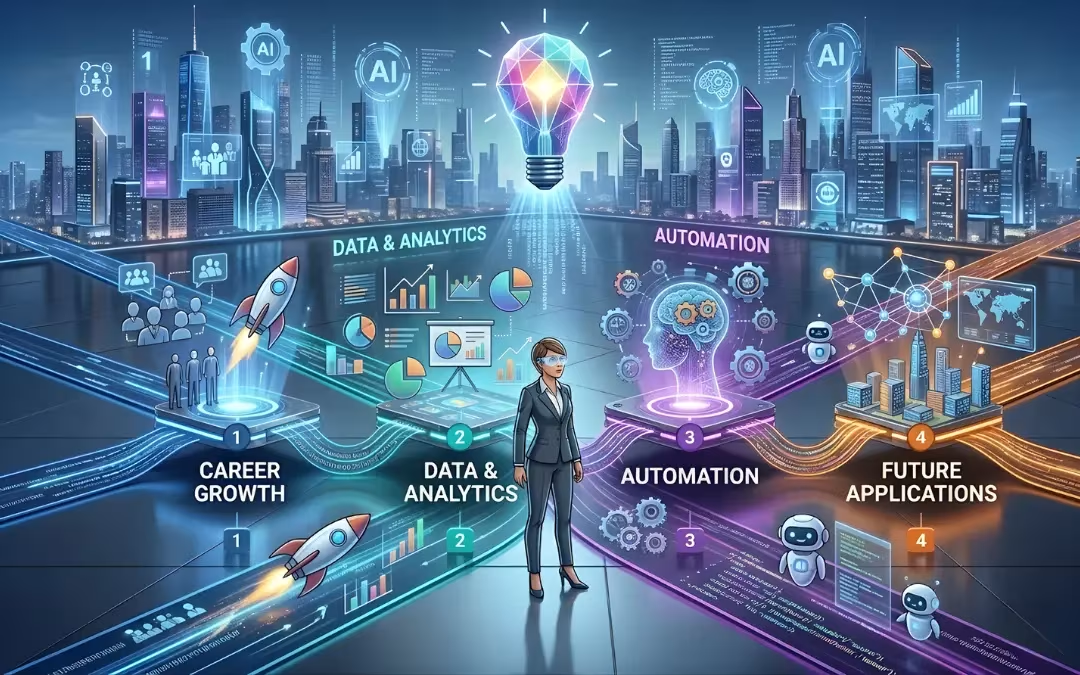
Artificial intelligence is creating new opportunities across technology, business, marketing, data, software development, and automation. For beginners, the best way to enter the field is to follow a structured learning path that starts with fundamentals and gradually moves toward practical AI projects and career specialization.
Understand the Basics of AI
Start by learning what artificial intelligence, machine learning, deep learning, generative AI, natural language processing, and computer vision mean. Understanding these concepts gives beginners a foundation for deciding which area of AI they want to explore.
At this stage, focus on concepts rather than advanced mathematics. Learn how AI models use data, how training and inference work, what datasets are, and why AI systems need evaluation.
Learn Python and Data Skills
Python is one of the most widely used programming languages for AI and machine learning. Beginners should learn variables, functions, loops, data structures, file handling, and basic programming logic.
Next, develop basic data skills. Learn how to collect, clean, analyze, and visualize datasets. Tools such as NumPy, pandas, and Matplotlib can help beginners become comfortable working with data.
Study Machine Learning
After learning programming and data fundamentals, move into machine learning. Important topics include supervised learning, unsupervised learning, classification, regression, clustering, feature engineering, and model evaluation.
Practice with small projects such as predicting prices, classifying text, identifying patterns in datasets, or building a basic recommendation system. Projects help connect theoretical concepts with real applications.
Learn Generative AI
Generative AI should be an important part of a modern AI learning roadmap. Beginners can explore large language models, prompt design, AI APIs, retrieval-augmented generation, text generation, image generation, and AI-powered applications.
Prompting is useful, but it should not be the only skill developed. Understanding data, evaluation, programming, problem-solving, and responsible AI practices provides a stronger foundation for building useful AI systems.
Build a Portfolio
Practical projects are one of the most valuable ways to demonstrate AI skills. Beginners can build applications such as chatbots, document summarizers, text classifiers, recommendation tools, data-analysis assistants, or AI-powered search systems.
For every project, explain the problem being solved, the technologies used, the development process, the results, and the limitations. A clear portfolio can help demonstrate practical ability when applying for internships, jobs, or freelance projects.
Choose a Career Direction
AI offers multiple career paths. Depending on interests and technical background, beginners can explore machine learning engineering, data science, AI application development, AI research, data engineering, AI automation, AI product management, or AI-focused business roles.
Different careers require different skills. Technical engineering roles generally require stronger programming and machine learning knowledge, while product and business roles may place greater emphasis on communication, product strategy, domain expertise, and understanding how AI can solve business problems.
Develop Professional Skills
AI careers also require skills beyond technology. Communication, analytical thinking, problem-solving, teamwork, documentation, and understanding business requirements can make technical knowledge more effective in professional environments.
Beginners should also learn about responsible AI, including privacy, security, bias, reliability, copyright, and the limitations of AI-generated information.
A Practical 2026 Learning Sequence
A beginner-friendly roadmap can follow this sequence: AI fundamentals, Python programming, data analysis, machine learning, generative AI, practical projects, specialization, and career preparation.
There is no need to learn every AI technology at the same time. Choose one learning objective, practice it through projects, review mistakes, and gradually increase the complexity of your work.
Prepare for AI Jobs
Once you have developed foundational skills and completed several projects, begin preparing for internships, junior roles, freelance opportunities, or AI-related positions that combine AI with another professional skill.
Your resume should focus on relevant skills and concrete projects rather than simply listing AI tools. During interviews, be prepared to explain how your projects work, why you selected particular technologies, how you evaluated the results, and what limitations remain.
Conclusion
Learning AI in 2026 does not require beginners to master every branch of artificial intelligence. A structured combination of fundamentals, Python, data skills, machine learning, generative AI, practical projects, and professional skills can provide a strong foundation for building an AI career.