
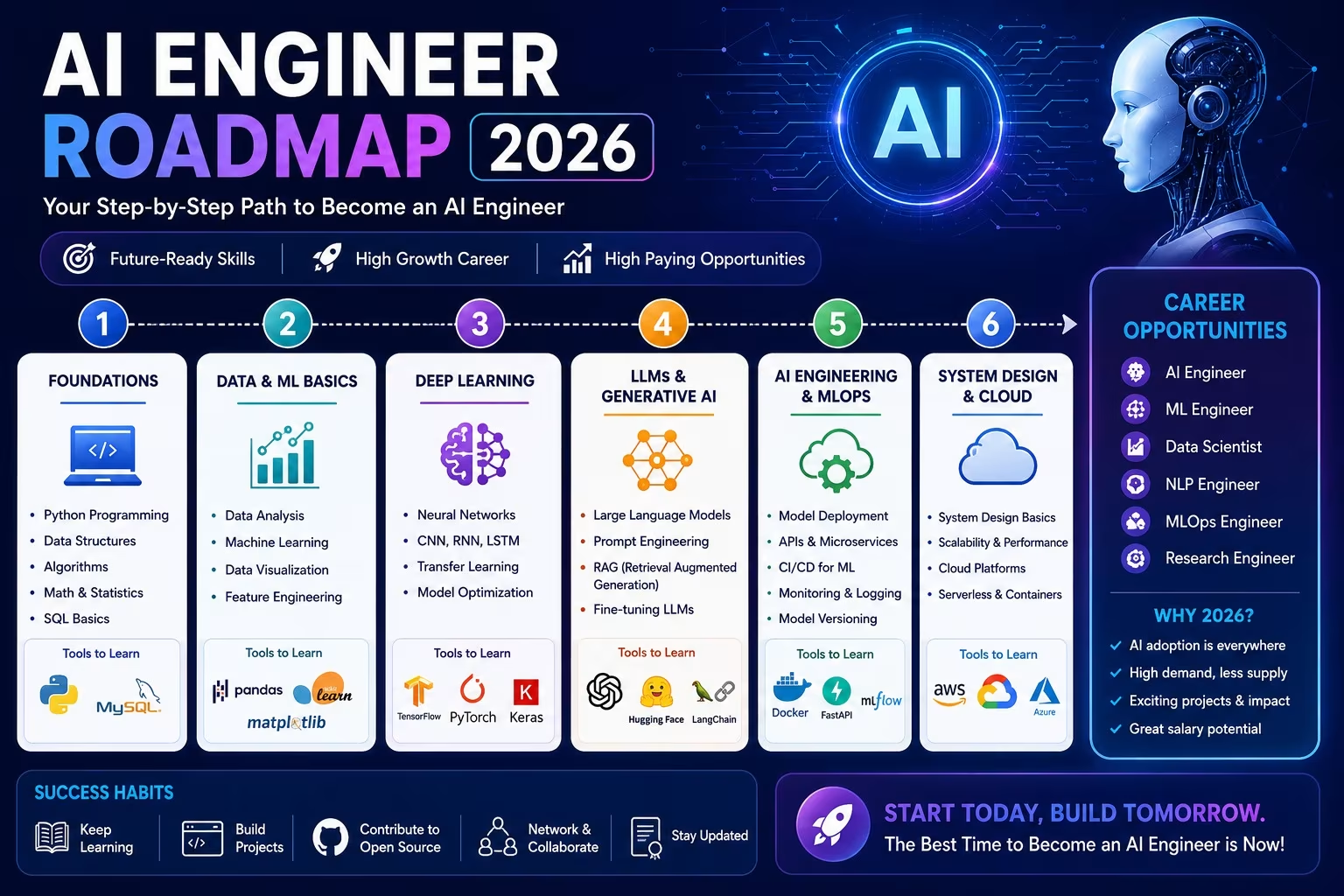
Artificial intelligence is becoming an important workplace skill across industries, creating new career opportunities for professionals with both technical and non-technical backgrounds. For working professionals, the path into AI can begin with basic AI literacy and progress through practical projects, specialization, strategy and leadership.
The first stage is learning how modern AI works and understanding where it can be applied. Professionals should become familiar with generative AI, large language models, machine learning basics, data, prompting, automation, AI limitations and responsible AI use.
Build AI literacy
Professionals do not necessarily need to become machine-learning engineers. The immediate goal is to become an effective AI user who can identify useful applications in everyday work.
This can include using AI for research, document preparation, data analysis, presentations, customer support, content workflows and repetitive administrative tasks.
Combine AI with existing expertise
The next step is to apply AI to an existing profession. A marketing professional can use AI for campaign analysis and content workflows, while a finance professional can explore reporting, forecasting and document analysis.
Operations professionals can investigate automation and process optimization, while managers can use AI for research, planning and decision support. Combining AI knowledge with existing industry expertise can create a practical career advantage.
Build practical projects
After learning the fundamentals, professionals should move from experimenting with AI tools to building useful solutions. Projects can include an internal knowledge assistant, an automated reporting workflow, a document-analysis system or a customer-support prototype.
Professionals moving toward technical AI positions can add Python, statistics, data handling, machine learning and model evaluation. Those targeting business or product roles can focus on AI workflow design, product strategy, process improvement and measuring business results.
Choose a specialization
Once the fundamentals are established, professionals can choose an area such as machine learning engineering, generative AI engineering, data science, AI product management, AI automation, AI consulting or AI governance.
Technical specialists may develop skills in retrieval-augmented generation, AI agents, model evaluation and deployment. Business-focused professionals can specialize in identifying AI use cases, managing implementation, measuring results and coordinating technical and non-technical teams.
Develop AI strategy skills
Moving into senior AI roles requires more than technical knowledge. Professionals need to understand business objectives, identify suitable AI use cases, manage implementation risks and communicate effectively with different teams.
AI strategy also involves understanding data quality, privacy, security, governance, costs and how AI projects should be evaluated. These skills become increasingly important as organizations move from individual AI experiments to larger deployments.
Move into AI leadership
The transition from AI practitioner to AI leader requires business judgment, communication, change management and team leadership alongside technology knowledge.
AI leaders may be responsible for setting priorities, selecting projects, allocating resources, developing talent and ensuring that AI initiatives support organizational objectives.
A five-stage career path
A practical roadmap can be organized into five stages: AI user, AI practitioner, AI specialist, AI strategist and AI leader.
At the AI user stage, the focus is on literacy and effective use of AI tools. The practitioner stage emphasizes workplace projects and measurable improvements.
The specialist stage develops deeper technical or functional expertise. The strategist stage adds business planning, governance and organizational transformation.
At the leadership stage, professionals take responsibility for AI-enabled products, teams, investments and broader business transformation.
Keep learning as AI evolves
An AI career roadmap cannot be treated as a one-time qualification. AI tools, workflows and required skills continue to change, making continuous learning an important part of professional development.
For working professionals, the transition can begin with everyday AI use and progress toward practical projects, specialization, strategy and leadership. Combining existing professional expertise with increasingly advanced AI capabilities provides a structured route toward higher-responsibility AI roles.