
Artificial intelligence is becoming an important career field across technology, finance, healthcare, manufacturing, marketing and other industries. Building a career in AI requires technical knowledge, practical experience, analytical thinking and an understanding of how AI systems are developed and used.
Start With the Fundamentals
A strong AI career begins with foundations in mathematics, statistics, programming and computer science. Python is widely used for AI and machine learning, while knowledge of algorithms, data structures and databases provides useful technical preparation.
Learn Machine Learning
Machine learning is a core area of artificial intelligence. Learners should understand supervised and unsupervised learning, model training, feature engineering, evaluation methods and common machine learning algorithms.
Develop Generative AI Skills
Generative AI has created new areas of expertise around large language models, prompt engineering, retrieval-augmented generation, embeddings and AI agents. Understanding how these technologies work can help professionals build practical AI applications.
Build Data Skills
Data is fundamental to many AI systems. AI professionals should learn how to collect, clean, analyse and prepare data while understanding data quality, bias, privacy and security considerations.
Create Practical AI Projects
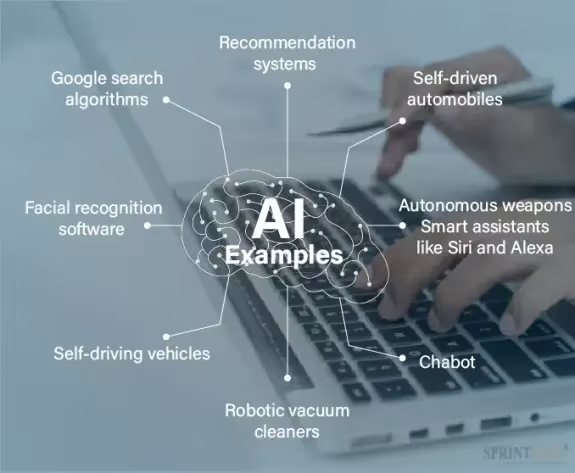
Hands-on projects are an effective way to develop and demonstrate AI skills. Examples include recommendation systems, document-analysis applications, prediction models, chatbots and AI-powered automation tools.
A professional portfolio should explain the problem being solved, the technology used, the development process and the results achieved.
Learn Deployment and MLOps
AI development does not end when a model is trained. Production systems may require APIs, cloud platforms, model deployment, monitoring, version control and automated workflows.
Learning MLOps can help professionals understand how AI models are moved from experimentation into reliable real-world applications.
Understand Responsible AI
AI professionals need to consider privacy, security, fairness, transparency, reliability and human oversight. Responsible AI practices are increasingly important as organisations deploy AI in sensitive and business-critical environments.
Keep Developing Your Skills
AI is changing rapidly, making continuous learning essential. Professionals can stay current by studying research, reading technical documentation, experimenting with new tools and building projects that address practical problems.
Latest Career Outlook
AI skills are increasingly relevant across a wide range of careers. A strong preparation path combines programming and machine learning fundamentals with generative AI, data analysis, deployment, responsible AI and practical project experience.