
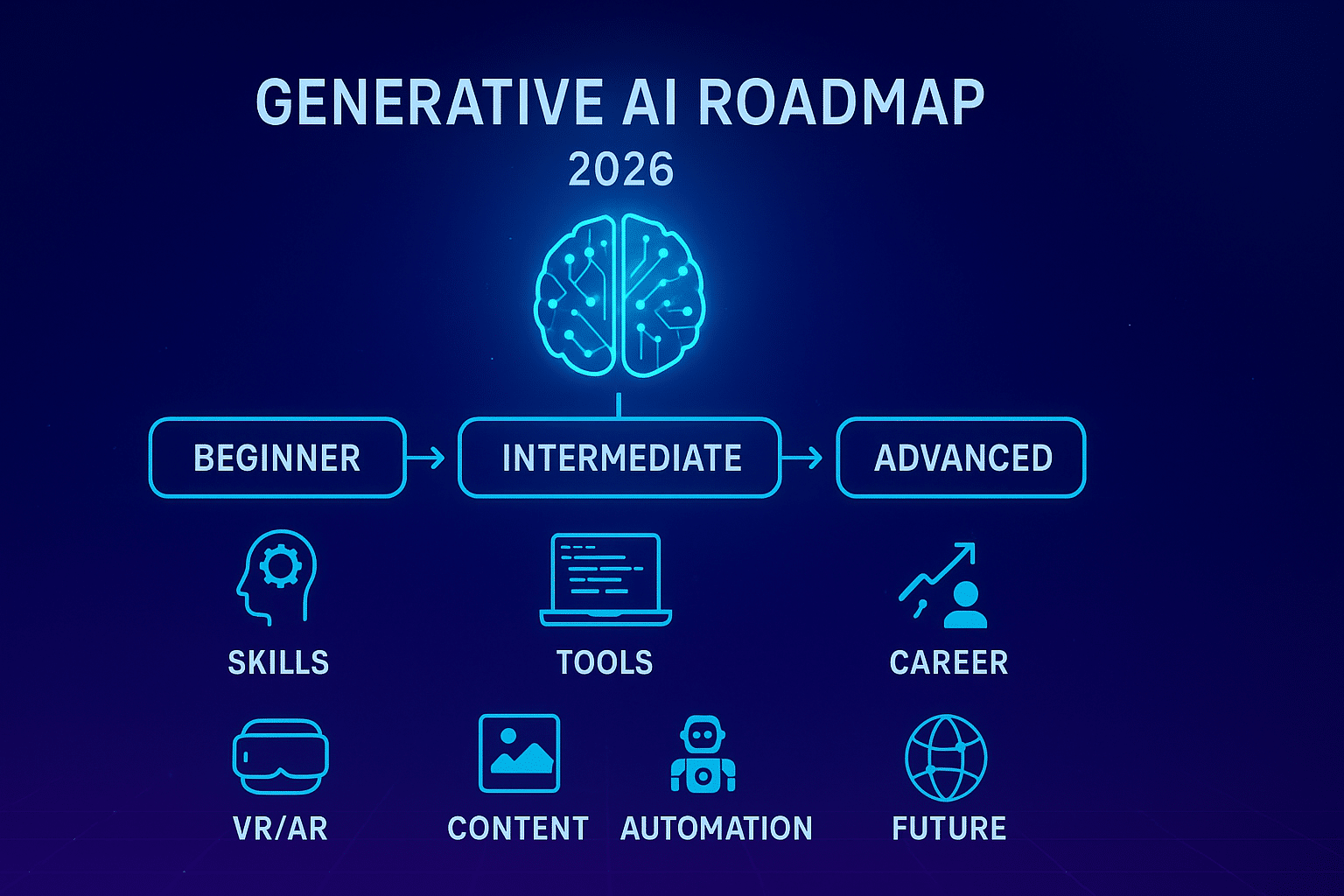
India’s generative AI push has moved from early experimentation toward a broader roadmap covering computing capacity, homegrown foundation models, workforce skills, public services and AI governance. In 2026, government programmes, industry plans and education initiatives are increasingly focused on turning generative AI into a practical part of India’s digital economy.
IndiaAI Mission expands its foundation
The government launched the IndiaAI Mission in March 2024 with an outlay of Rs 10,372 crore to build a national artificial intelligence ecosystem. The mission has since focused on computing infrastructure, indigenous AI models, datasets, startup support, skills and responsible AI development.
India’s efforts to build domestic foundation models have also accelerated. Several Indian teams are developing large language and multimodal models intended to support Indian languages, speech, vision and applications designed around local requirements.
Indian-language AI becomes a major focus
BharatGen is one of the major initiatives connected to India’s generative AI strategy. Led by IIT Bombay under the National Mission on Interdisciplinary Cyber-Physical Systems, the project is developing foundational models for language, speech and computer vision.
The initiative is designed around multilingual and multimodal AI, Indian datasets and an open-source approach. Its objective is to create systems that can better represent India’s languages and cultural contexts while making generative AI more accessible to researchers, startups, government institutions and other users.
Skills become part of the AI roadmap
The 2026 generative AI learning path increasingly combines traditional software and machine-learning skills with newer technologies. Python, data handling, machine learning and deep learning are commonly followed by transformers, large language models, embeddings, retrieval-augmented generation and AI agents.
Training programmes are also placing greater emphasis on practical development. Projects involving chatbots, document question-answering systems, AI automation, model evaluation and deployed applications are being used to demonstrate real-world generative AI skills.
NITI Aayog has highlighted reskilling and AI fluency as important factors in how India responds to changes in the labour market. Its work on the AI economy has examined opportunities for productivity, technology services, research and development and workforce transformation.
Generative AI enters the economic strategy
India’s wider AI strategy increasingly treats generative AI as an economic technology rather than only a research field. Government policy discussions have focused on productivity, research, technology services, entrepreneurship and the creation of new AI-enabled businesses.
Indian startups are working across areas including foundation models, multilingual AI, speech technology, text-to-audio, text-to-video, enterprise automation, e-commerce, marketing, engineering, analytics and healthcare.
Government use moves toward implementation
The IndiaAI Mission is also expanding AI adoption within government. By 2026, government departments were identifying potential AI use cases and developing plans for applying the technology to public services, administration and decision-support systems.
The shift reflects a broader move from AI experimentation toward implementation. Government agencies, research institutions and technology companies are increasingly testing how generative AI can be integrated into existing digital infrastructure.
Governance develops alongside innovation
India’s generative AI roadmap also includes safeguards for the technology. The country’s AI governance work addresses issues including accountability, safety, fairness, data protection, cybersecurity and the authentication of AI-generated content.
The policy framework reflects concerns that accompany increasingly capable generative and agentic systems, including misinformation, bias, privacy risks and cybersecurity threats. The government has also linked responsible AI development with existing digital and data-protection frameworks.
The roadmap for 2026
India’s generative AI roadmap now spans several connected areas: computing infrastructure, domestic foundation models, Indian-language datasets, research, workforce training, startup development, government applications and AI governance.
The next phase will depend on how these initiatives move from research programmes and pilots into reliable systems used by businesses, researchers, public institutions and citizens. India’s AI ecosystem continues to develop through the IndiaAI Mission, indigenous model projects, skills programmes and emerging governance frameworks.